
3. The Iterative Process: How It Works

Simple yet profound is the iterative process underlying the Mandelbrot set. Starting with a simple mathematical equation, this iterative approach has wide and complex ramifications. We must explore the mechanics of iteration and the relevance of the outcomes if we are to grasp how the Mandelbrot set is generated.
The Mandelbrot set is generated from a core equation \( z = z^2 + c \). Here \( z \) is a complex number beginning at zero; \( c \) is another complex number varying over the complex plane. Starting at an initial position \( c \) the method iteratively uses the equation. We keep updating \( z \) using the past outcome for every point \( c \) until either \( z \) stays limited inside a given threshold or escapes to infinity.
Consider a particular point \( c \) in the complex plane to show this procedure. Starting \( z_0 = 0 \), First iteration yields \( z_1 = z_0^2 + c = 0 + c = c \)\ The second iteration produces \( z_2 = z_1^2 + c = c^2 + c \); this goes on endlessly. Whether the values of \( z_n \) remain limited or escape is the crucial concern.
The Mandelbrot set includes a point \( c \) if the sequence of \( z_n \) values does not tend towards infinity as \( n \) approaches infinity. Practically speaking, we can find boundedness by defining a limit; if the magnitude of \( z_n \) surpasses a given value—usually 2—we can say the point is not in the Mandelbrot set. Repeated for every point \( c \) in the complex plane, this procedure generates a thorough map of the set.
The beauty of this iterative approach is found in its capacity to produce elaborate and difficult designs. We find a broad spectrum of behaviours as we alter \( c \) over the complex plane. While some points remain limited, producing a rich tapestry of forms and structures, others lead to sequences that rapidly escape to infinity.
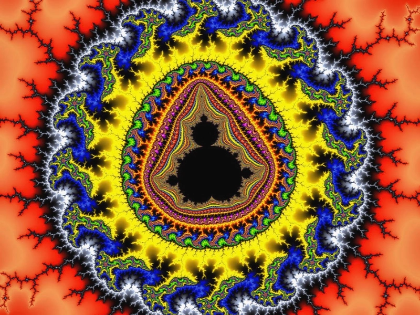
Specifically intriguing is the Mandelbrot set’s boundary. Here the most complex and exquisite patterns show themselves. Every time we enlarge on the boundary, we find fresh details exposing a limitless range of self-similarly shaped objects. A feature of fractals, this phenomena occurs where similar patterns reoccur at several levels.
Moreover, the iterative process has great consequences in many disciplines; it is not only a mathematical curiosity. The Mandelbrot set has motivated many visual depictions in computer graphics, hence highlighting the interaction between mathematics and art. Both mathematicians and artists have started to find great interest in the process of visualising the set since it shows the beauty inherent in mathematical forms.
All things considered, the iterative process producing the Mandelbrot set is a neat and effective approach that highlights mathematical relationship complexity. We can investigate the complex beauty of the Mandelbrot set by means of simple iterations of a basic equation, therefore stressing the close relationships among mathematics, art, and chaos theory. The iterative character of this approach encourages us to value the infinite possibilities and richness of the mathematical universe.