
3. The Iterative Process: How It Works

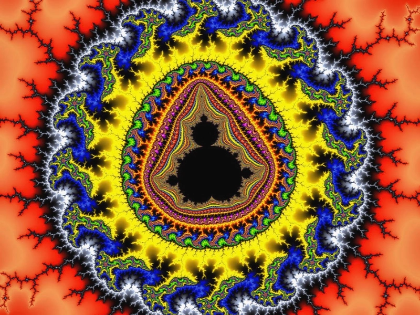
Simple yet profound is the iterative process underlying the Mandelbrot set. Starting with a simple mathematical equation, this iterative approach has wide and complex ramifications. We must explore the mechanics of iteration and the relevance of the outcomes if we are to grasp how the Mandelbrot set is generated.
The Mandelbrot set is generated from a core equation \( z = z^2 + c \). Here \( z \) is a complex number beginning at zero; \( c \) is another complex number varying over the complex plane. Starting at an initial position \( c \) the method iteratively uses the equation. We keep updating \( z \) using the past outcome for every point \( c \) until either \( z \) stays limited inside a given threshold or escapes to infinity.
Consider a particular point \( c \) in the complex plane to show this procedure. Starting \( z_0 = 0 \), First iteration yields \( z_1 = z_0^2 + c = 0 + c = c \)\ The second iteration produces \( z_2 = z_1^2 + c = c^2 + c \); this goes on endlessly. Whether the values of \( z_n \) remain limited or escape is the crucial concern.
The Mandelbrot set includes a point \( c \) if the sequence of \( z_n \) values does not tend towards infinity as \( n \) approaches infinity. Practically speaking, we can find boundedness by defining a limit; if the magnitude of \( z_n \) surpasses a given value—usually 2—we can say the point is not in the Mandelbrot set. Repeated for every point \( c \) in the complex plane, this procedure generates a thorough map of the set.
The beauty of this iterative approach is found in its capacity to produce elaborate and difficult designs. We find a broad spectrum of behaviours as we alter \( c \) over the complex plane. While some points remain limited, producing a rich tapestry of forms and structures, others lead to sequences that rapidly escape to infinity.
Specifically intriguing is the Mandelbrot set’s boundary. Here the most complex and exquisite patterns show themselves. Every time we enlarge on the boundary, we find fresh details exposing a limitless range of self-similarly shaped objects. A feature of fractals, this phenomena occurs where similar patterns reoccur at several levels.
Moreover, the iterative process has great consequences in many disciplines; it is not only a mathematical curiosity. The Mandelbrot set has motivated many visual depictions in computer graphics, hence highlighting the interaction between mathematics and art. Both mathematicians and artists have started to find great interest in the process of visualising the set since it shows the beauty inherent in mathematical forms.
All things considered, the iterative process producing the Mandelbrot set is a neat and effective approach that highlights mathematical relationship complexity. We can investigate the complex beauty of the Mandelbrot set by means of simple iterations of a basic equation, therefore stressing the close relationships among mathematics, art, and chaos theory. The iterative character of this approach encourages us to value the infinite possibilities and richness of the mathematical universe.
4. The Fractal Nature of the Mandelbrot Set
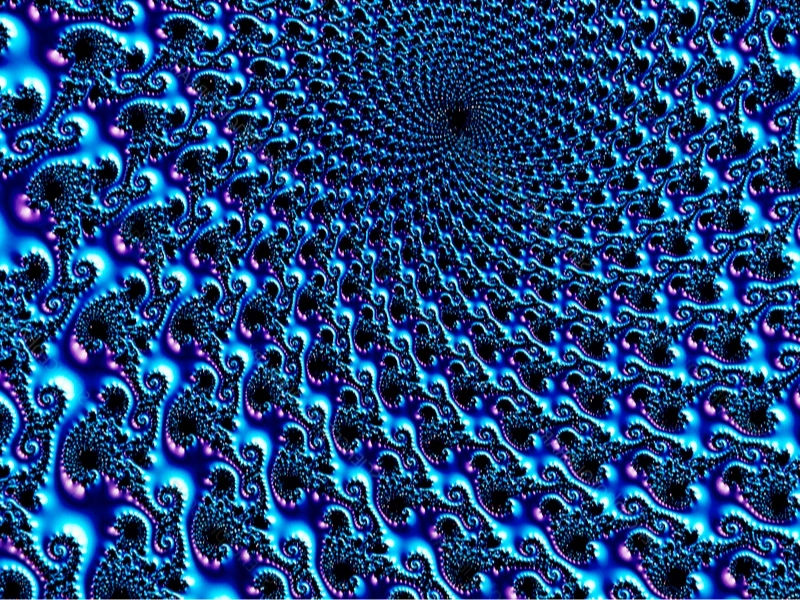
The Mandelbrot set’s fractal character is among its most amazing features. Complex structures called fractals show self-similarity over several sizes, therefore similar patterns can be seen independent of your zooming in or out. This quality makes the Mandelbrot set a prime example of fractal geometry, highlighting the beauty of mathematical structures that seem in art and nature.
Mathematical scientist Benoit Mandelbrot first used the term “fractal” after he realised fractal geometry could adequately explain numerous natural occurrences. Fractals differ from conventional geometric forms in that their irregularity and intricacy define them instead of their frequently smooth and regular nature. The Mandelbrot set best illustrates this idea since its boundary is infinitely complex and detailed.
Investigating the Mandelbrot set’s boundary reveals that it is a complicated structure full of miniatures of itself, not only a basic curve. We find smaller replicas of the whole set, each with distinctive characteristics as we enlarge on the limit. Fractals are distinguished by their self-similarity, which also fuels limitless investigation of forms and patterns.
When we enlarge on a particular area of the Mandelbrot set, for instance, we could find complex spirals, jagged edges, and whirling forms that match the general set architecture. This phenomena never ends; even with increasing zoom, we will always uncover fresh details reflecting the more general pattern. For mathematicians, artists, and scientists equally, the Mandelbrot set fascinates them because of its limitless complexity.
Furthermore, the Mandelbrot set’s fractal character has important ramifications in other spheres. Fractals are used in computer graphics to replicate realistically natural environments such coastlines, mountains, and clouds. Fractals’ self-similar characteristics let one create complex textures and patterns that reflect the intricacy of nature.
Apart from its uses in graphics and art, the Mandelbrot set’s fractal character has been noted in other branches of science. Fractals abound in the branching patterns of trees, the architecture of blood vessels, and the universe’s galaxy dispersion. This implies that the fundamental ideas of fractals are profoundly ingrained in the fabric of reality and expose a link between mathematics and the surroundings.
Fractal analysis also begs interesting issues regarding the nature of infinity and the boundaries of human knowledge. The Mandelbrot set questions our conceptions of dimension and space since it resides in a mathematical domain that rejects accepted measurements. It asks us to consider the great complexity resulting from basic interactions and guidelines.
Finally, the Mandelbrot set’s fractal character is a fascinating feature that emphasises the elegance and intricacy of mathematical construction. Its self-similar characteristics bridge mathematics, art, and the natural world and inspire limitless investigation of patterns and forms. The Mandelbrot set reminds us of the complexity of the mathematical terrain and invites us to value the complex links found inside chaos and order.
 zi ang