
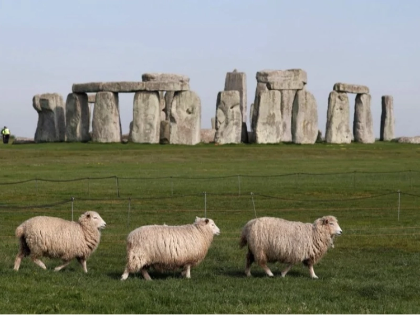
5. Stonehenge as a Prehistoric Computer

Although calling Stonehenge a “computer” seems antiquated, many experts think that this ancient structure served as a sophisticated computing tool for tracking and cosmic event prediction. Stonehenge essentially might have been a prehistoric analogue computer with advanced astronomical computation capability.
Stonehenge’s layout and placement of its several components provide the basis of the computational device theory. For instance, the Aubrey Holes are believed to have been absolutely vital in this early computing system. Ancient astronomers may have followed the 18.6-year cycle of the moon’s orbital nodes by arranging marks around these 56 holes in a particular configuration, therefore enabling precise predictions of lunar and solar eclipses.
This system would have needed a thorough awareness of celestial cycles as well as the capacity to transform that information into a physical, manipulable model. Though far different from our contemporary digital computers, this type of computation was nevertheless able to process and forecast complicated astronomical data.
For this primitive computer, the trilithons and other stone configurations might have provided a form of visual interface. The ancient astronomers may have “read” the result of their calculations by seeing how the sun and moon lined with particular stones at different times of the year. This would have let them forecast seasonal variations, monitor time passing, and expect significant astronomical events.
Furthermore, some experts speculate that even more complicated computations might have been done at Stonehenge. The placement of the stones, for instance, would have made it possible to forecast lunar eclipses—complex cycles repeating almost every 19 years. Until the Greek astronomer Meton of Athens fully documented this cycle—known as the Metonic cycle—Western astronomy was not equipped to handle it. The possibility that Stonehenge’s builders included this cycle into their monument points to a degree of astronomical understanding much ahead of its time.
Stonehenge as a prehistoric computer questions our understanding of ancient knowledge and ability. It implies that our Neolithic predecessors were not only sharp night sky watchers but also accomplished mathematicians and engineers able to create intricate computer models of celestial mechanics.