
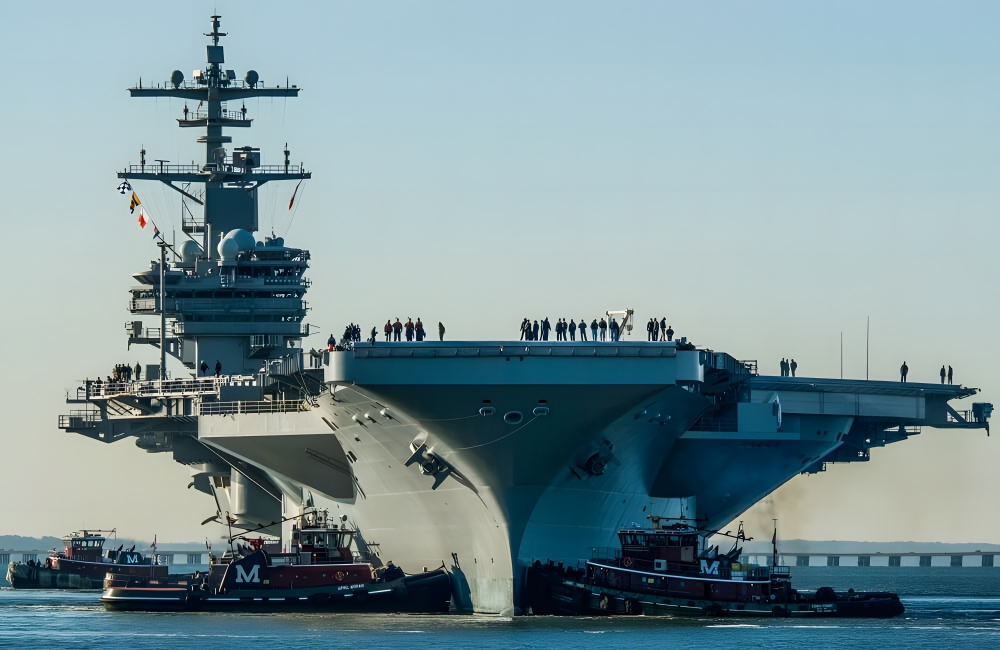
USS George H.W. Bush ©gmeland/Shutterstock
The defense industry is one of the most profitable trades in the world. In America alone, the total sales from the defense sector comprises $389 billion, with companies like Lockheed Martin taking the lead. Globally, it boasts profits of over $760 billion. A huge part of that revenue comes from aerospace technology.
The profitability and sheer value of the defense industry is remarkable, especially when you consider the fact that it is far younger than other industries. The US Army Signal Corps bought the first warplane in 1909 when they purchased a Wright Model A for $30,000. A century later, the US defense budget is $686.1 billion.
When it comes to pure military technological power, America’s armed forces are second to none. The U.S. government has invested billions in researching, developing and perfecting America’s arsenal with the latest advanced tech. Much of this money is spent on tanks, ships and aircrafts – all to further America’s advances in technology and power. These vehicles are some of the most expensive in the world, and you are about to find out why.
1. Bell Boeing V-22 Osprey
Entered Service:1989
Manufacturer: Bell Textron & Boeing
Cost: $118 million*
Two of the world’s leading defense firms created the Bell Boeing V-22 Osprey. After a late-eighties military crisis underscored the need for a new vertical-takeoff, long-range, high-speed aircraft, the DOD tapped Textron Inc and Boeing Co. to build the multi-mission aircraft as quickly as possible. The V-22 Osprey flew its first mission in 1989.
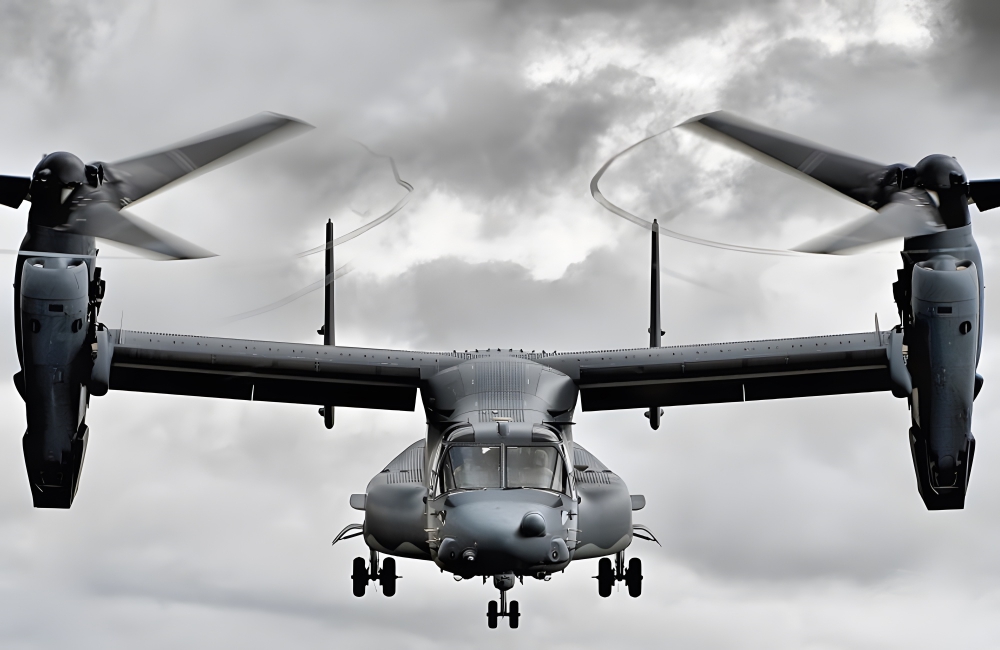
Bell Boeing V-22 Osprey @bullseye2100 / Twitter.com
The Osprey is designed with the functionality of a regular helicopter. However, it has the high-speed, long-range cruise performance that you normally find on a turboprop aircraft, giving the Osprey both practicality and lethality. The Marine Corps, Air Force, Navy and Japan Ground Self-Defense Force all use the V-22 Osprey.
Development of the Bell Boeing V-22 Osprey was protracted and rather controversial. It was so costly to begin with, and the cost continued to increase. In 2001, an LTC was relieved of duty after he falsified records to make the Osprey appear more reliable. Despite these hiccups, the Osprey was put into full-rate production in 2005.
2. USS Gerald R. Ford
Entered Service: 2022 (TBD)
Manufacturer: Newport News Shipbuilding
Cost: $13 billion*
Construction of this large warship began on August 11, 2005. Northrop Grumman held a ceremony where they cut steel for a fifteen-ton plate (part of the side shell of the carrier). The keel was laid down a few years later in November of 2009. In November of 2013, she was christened.
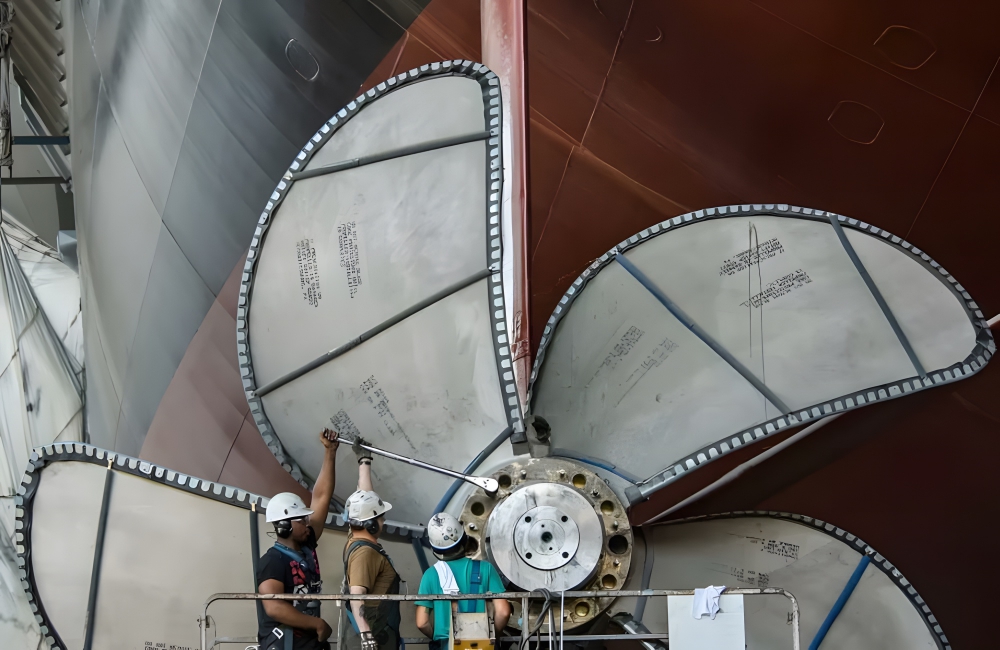
Christening of the USS Gerald Ford @verge / Twitter.com
At one point, the USS Gerald R. Ford was the largest aircraft carrier in the world – and one of the most expensive crafts of any kind in the US military. This incredible feat of engineering was conceived more than 15 years ago, with construction requiring many years and thousands of workers.
After a few delays, the USS Gerald R. Ford was finally commissioned and delivered to the Navy in 2017. Most of this vessel’s features have all been tested and approved, though it is not yet scheduled to disembark until sometime in 2022.
3. Northrop Grumman B-2 Spirit
Entered Service: 1989
Manufacturer: Northrop Grumman
Cost: $2.1 billion*
Northrop Grumman is one of the largest defense manufacturers in the world, with revenues of over $30 billion per year. One of Northrop Grumman’s best-known creations was the B-2 Spirit. Also called the Stealth Bomber, this heavy strategic bomber had technology designed to penetrate dense anti-aircraft defenses.
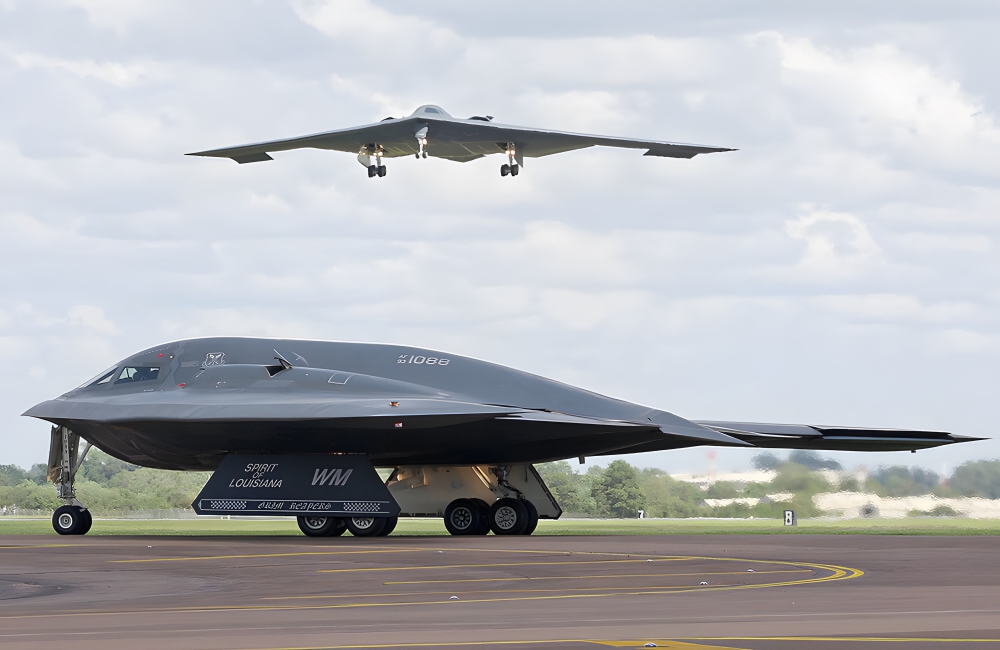
Northrop Grumman B-2 Spirit @ron_eisele / Twitter.com
The B-2 Spirit is designed to fly with a crew of just two people, and it uses both thermonuclear and conventional weapons. This Northrop Grumman Corp jet had its first flight in 1989, and it was produced until 2000. Nineties-era Stealth Bombers are still in use today, though the high cost made the project unsustainable for long. 21 were made.
Budgetary reasons were a cause of the earlier retirement of the B-2. The Air Force was planning to operate these Stealth Bombers until 2058, but the fiscal year budget for 2019 necessitated that the USAF operate them until 2032 (and no later). The B-1’s retirement date also moved up to 2036.
4. Virginia Class Submarine
Entered Service: 2004
Manufacturer: Huntington Ingalls Industries, General Dynamics Electric Boat, Newport News Shipbuilding
Cost: $2.5 billion*
The US Navy signed a contract with General Dynamics and Huntington Ingalls to build these super-fast SNN subs. The Virginia submarine is the latest in undersea strategy. It’s not all muscle; it also is high-tech and on the cutting edge for intelligence gathering. The Virginia is replacing the Los Angeles class subs, many of which were decommissioned.
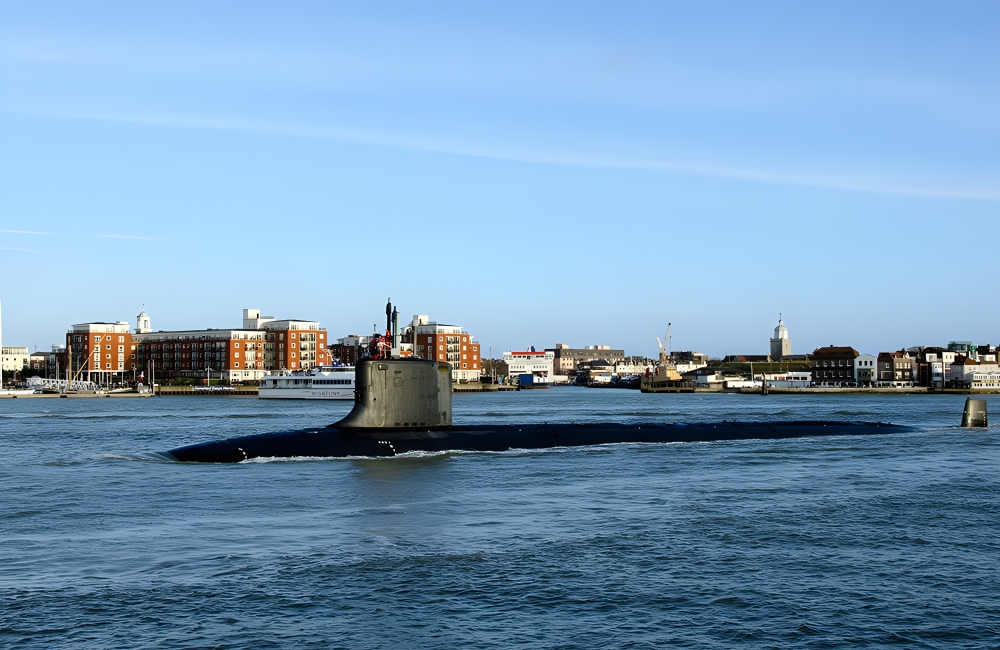
Virginia Class Submarine © Paul J Martin / Shutterstock
Despite early technological barriers, the Virginia-class submarines got some really cool weaponry in the end. They received photonic masts, improved sonar systems, new rescue equipment, a high-energy laser weapons system, and a nine-man lock-out chamber. The Ship Control system is now optical fiber fly-by-wire. The Virginia-class sub runs on the 3512B V-12 marine diesel engine.
One Virginia submarine costs $2.8 billion to make. Sixty-six new Virginia subs are planned, with six on order right now. Seventeen have been completed thus far since 2004. They will remain in service until 2060, at least, with some reaching until 2070.
5. Northrop Grumman E-2D Advanced Hawkeye
Entered Service: 1960
Manufacturer: Northrop Grumman
Cost: $232 million*
The E-2 Hawkeye is an all-weather tactical AEW (Airborne Early Warning) carrier-capable aircraft. The twin-turbo craft was designed in the late fifties, and the US Navy was the first military branch to receive it. The E-2 Hawkeye replaced the E-1 Tracer, which has become obsolete nowadays.
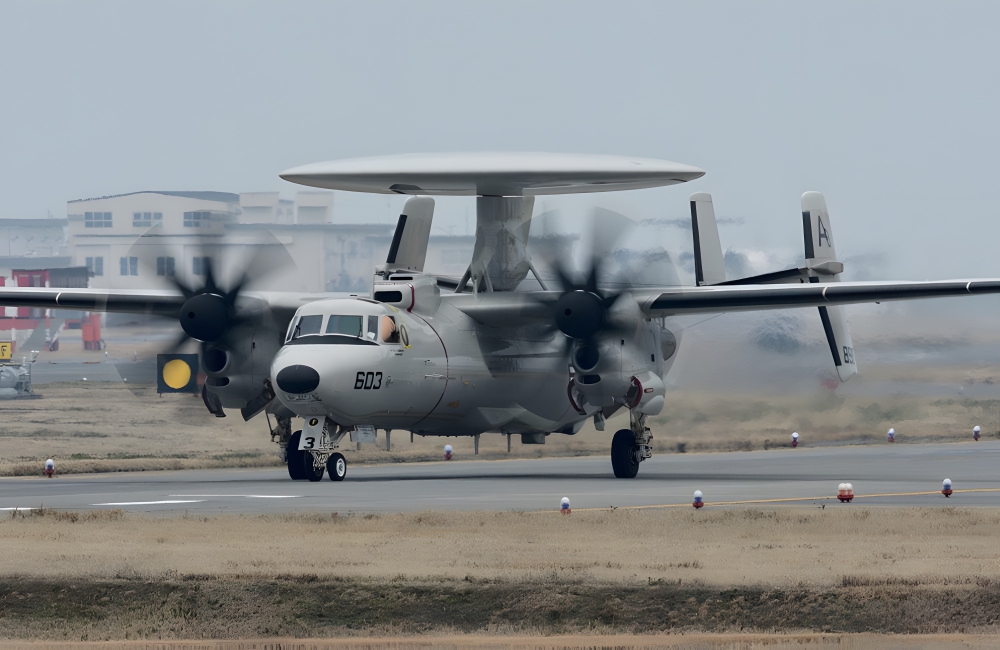
Northrop Grumman E-2D Advanced Hawkeye ©viper-zero / Shutterstock
Over time, the Northrop Grumman Corp plane has received several much-needed updates, such as E-2B and E-2C technology, which has boosted the radar and radio communications. The E-2D Hawkeye had its first flight in 2007. It has been nicknamed “Hummer” because of the noise from the turboprop engines. The US, along with seven other countries, uses the E-2.
The APY-9 radar on the E-2 Advanced Hawkeye is able to detect fighter-sized stealth planes. The APY-9 is allegedly able to target fifth-gen fighters like the Shenyang J-31, the Chengdu J-20, and the Sukhoi Su-57. Lockheed and Northrop Grumman designed the APY-9 to solve the previous shortcomings of UHF radar systems.
6. F-15 Eagle
Entered Service: 1972
Manufacturer: McDonnell Douglas, Boeing
Cost: $43.1 million*
Boeing teamed up with McDonnell Douglas, its subsidiary, to create the McDonnell Douglas F-15 Eagle. This twin-engine tactical fighter aircraft can fly in all weather systems. Back in the late sixties, the UAF reviewed a slew of proposals from leading defense manufacturers for a dedicated air superiority fighter.
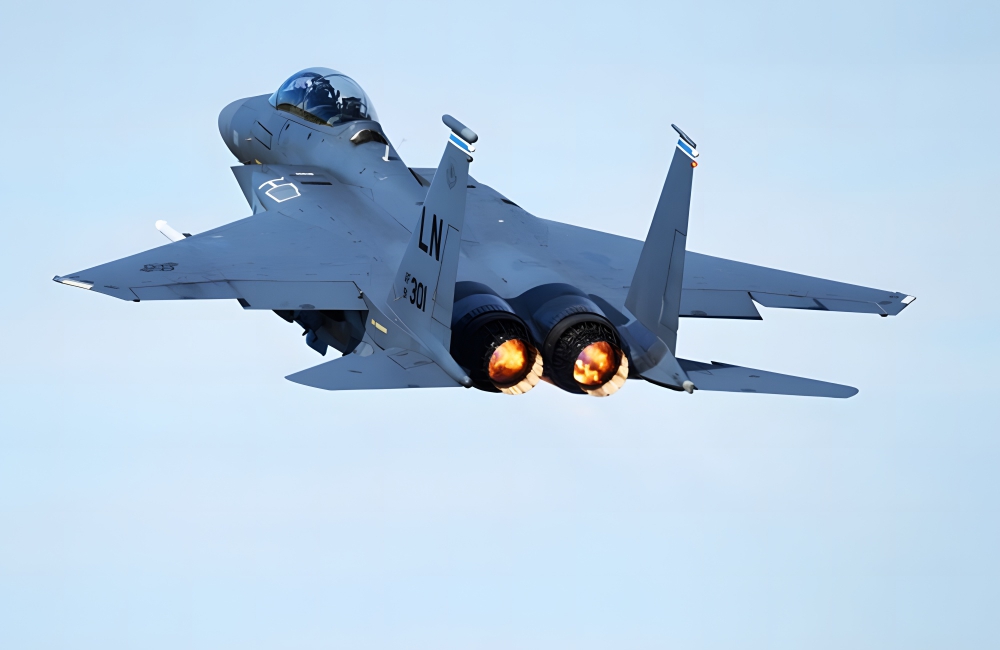
F-15E Strike Eagle @kadonkey / Twitter.com
It chose the Boeing Co design. The design took five years (from 1967 until 1972) to implement. The F-15 Eagle is one of the world’s most successful modern jet fighters, with more than 100 victories and zero losses in aerial combat. The F-15 Eagle is a favorite of not only the USAF, but also the Israeli Air Force.
The F-15E, which is one of the F-15 Eagle’s latest variations, will remain in service for years to come. The Pentagon also reportedly wants twelve new F-15X fighters to replace the F-15Cs that the Air National Guard uses. The F-15E has low hour numbers on the airframes and a primary air-to-ground role, so it won’t be going anywhere for a while.
7. E-2D Hawkeye
Entered Service: 1960
Manufacturer: Northrop Grumman
Cost: $232 million*
Described by manufacturer Northrop Grumman as a “game changer” for the Navy, the E-2 Hawkeye is a twin-turbo aircraft that was designed to replace the E-1 Tracer. The E-2D is an airborne early warning aircraft. It is carrier-capable and can fly in all weather. This impressive aircraft has been in production since 1960, the year of its first flight.
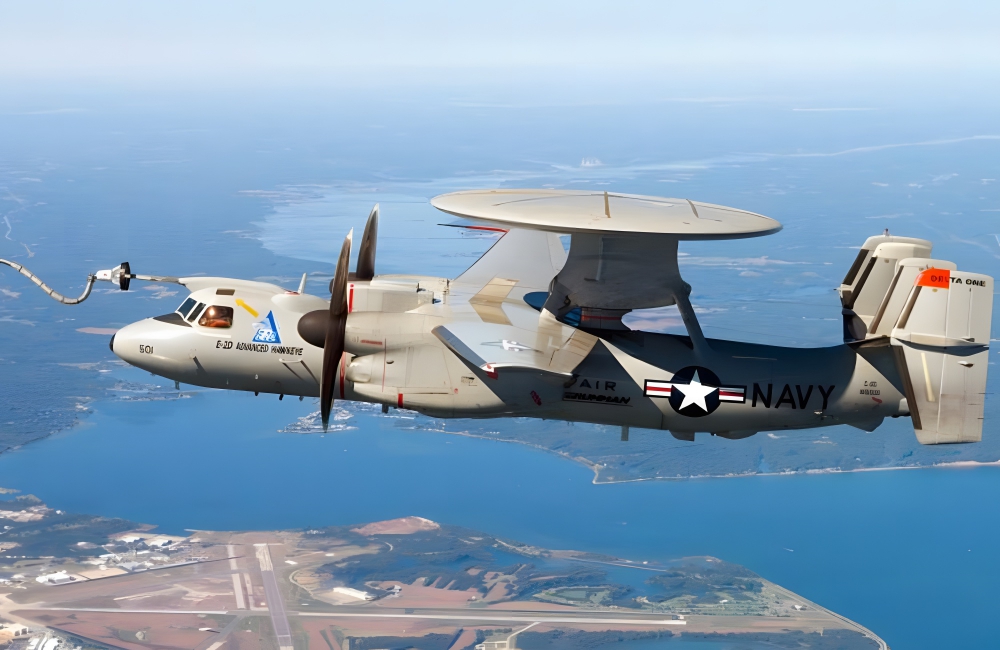
E-2D Hawkeye @northropgrumman / Twitter.com
This Northrop Grumman plane is primarily used by the Navy. Later, the E-2 would be developed into the Grumman C-2 Greyhound. So far, 313 E-2 Hawkeye planes have been built. The E-2 has been nicknamed “Super Fudd” and “Hummer,” the latter for its distinctive engine sounds.
The E-2D Hawkeye differs from the aforementioned E-2D Advanced Hawkeye because it doesn’t have the avionics suite. The new avionics suite (including the APY-9 radar) also comes with an upgraded mission computer, radar suite, flight management and integrated satellite systems, new engines, and a glass cockpit to enable aerial refueling.
8. DDG 1000 Zumwalt-Class destroyer
Entered Service: 2016
Manufacturer: Bath Iron Works
Cost: $7 billion*
The crème de la crème of stealth ships, the Zumwalt Destroyer is a guided missile destroying stealth ship that is focused on land activity. The anti-aircraft ship is far larger than other cruisers or destroyers, and it reaches a top speed of thirty knots. It is in use for the US Marines.
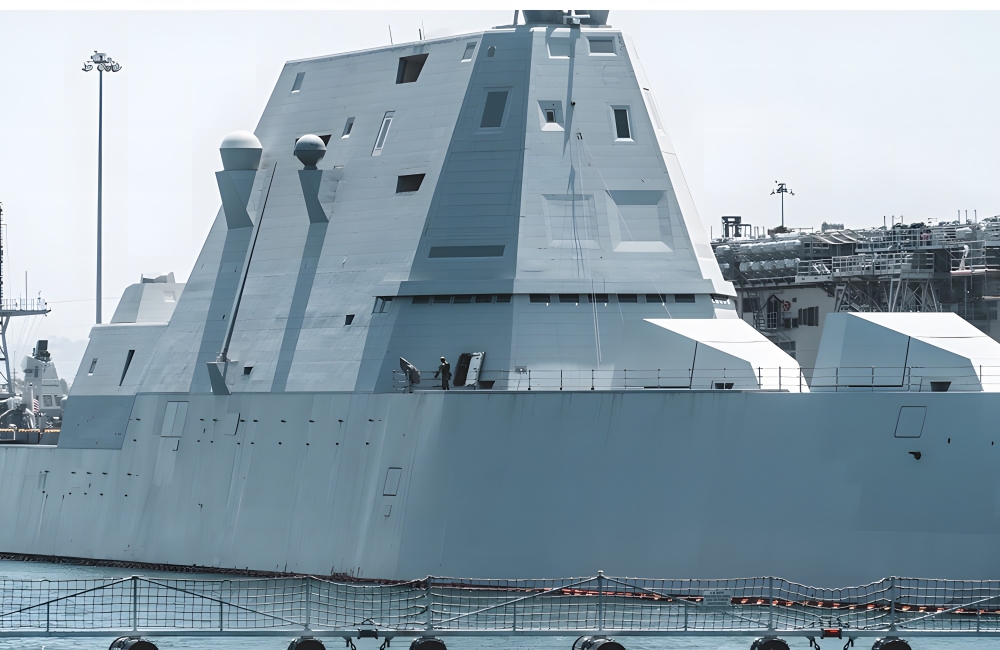
DDG 1000 Zumwalt-Class destroyer © Lukas Prosch / Shutterstock
Two Rolls Royce turbines power the Zumwalt, and currently, three have been completed on the $22.5 billion program cost. Thirty-two were planned, and two are active. The cost to build one is $7 billion. The Zumwalt is so expensive because it has a Total Ship Computing Environment Infrastructure.
An important thing to know about the Zumwalt is the man after which it was named. Admiral Elmo Zumwalt served as the nineteenth Chief of Naval Operations. He reformed the Navy’s personnel policies, improving the life of enlisted sailors and easing burgeoning racial tensions. Admiral Zumwalt had a naval career totaling 32 years.
9. B-52 Stratofortress
Entered Service: 1955
Manufacturer: Boeing
Cost: $14.43 million*
The B-52 Stratofortress had its first flight in 1952, and it was introduced to the USAF and NASA in the mid-fifties. So far, 744 have been built. The B-52 was originally designed as a straight-wing aircraft with six engines, but it now has swept wings and eight turbo-jet engines. The B-52 was built during the Cold War.
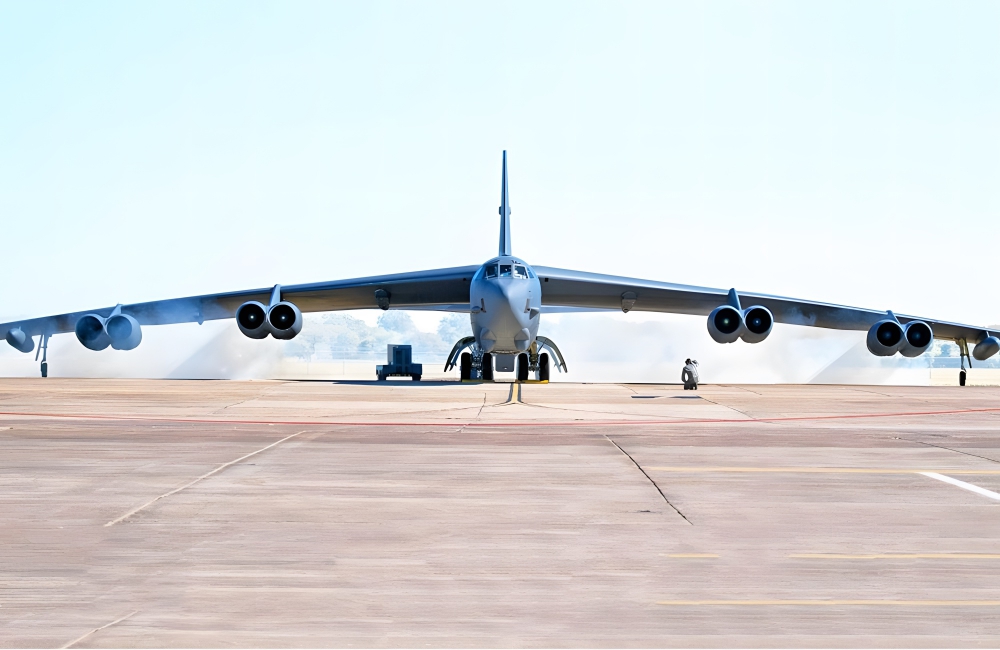
B-52 Stratofortress @MOTORIZADO / Youtube.com
Boeing originally created the B-52 to carry nuclear arms on deterrence missions during the Cold War. The B-52 has only ever dropped conventional munitions (not nukes) in combat so far. The “Stratofortess” nickname is rarely used—the official Air Force nickname for the B-52 is actually the “B.U.F.F.”
The reason that the Stratofortess has been kept in service, though there are so many other more advanced bombers like the B-58 Hustler, B-70 Valkyrie, and the B-1 Lancer, among others, is its superior performance. It also has lower operating costs and high subsonic speeds. These bombers will serve into the 2050s.
10. P-8A Poseidon Plane
Entered Service: 2013
Manufacturer: Boeing
Cost: $256 million*
Another Boeing masterpiece is the Boeing P-8 Poseidon, which is a maritime patrol aircraft that was introduced in 2013 and had its first test flight in 2009. The Poseidon, so named after the God of the Sea from Greek mythology, is an ASW and ASUW aircraft. It is one of eight built as of January 2019.
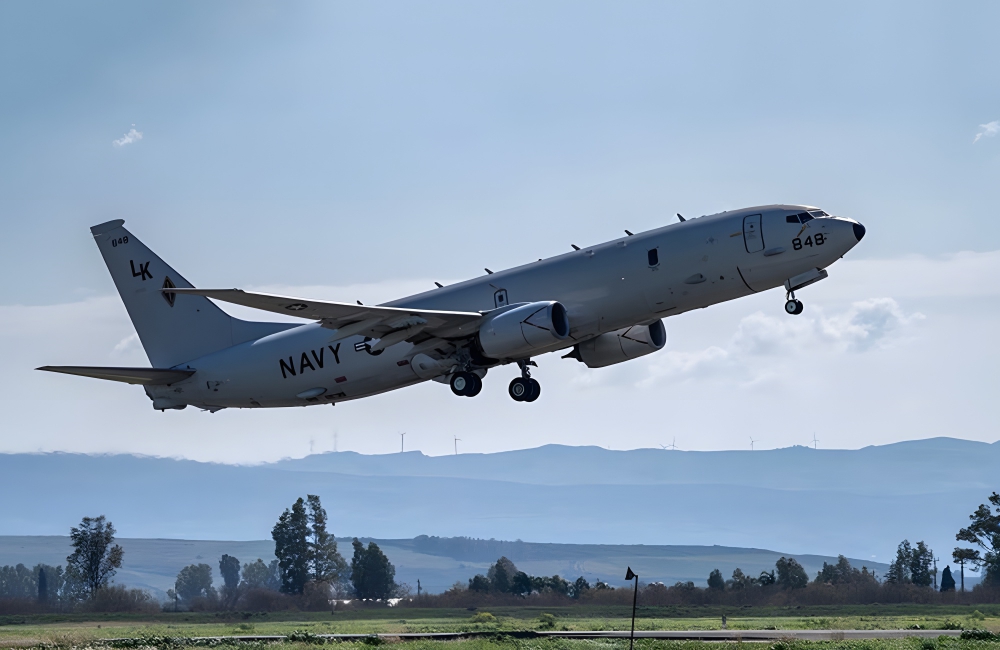
P-8A Poseidon @izvestia_ru / Twitter.com
The Poseidon is used by the US Navy, as well as the RAAF, RAF, RNoAF, RNZAF, and ROKN. The Naval Air Systems Command proceeded with full speed production in 2013 after a successful launch. They gave Boeing the $2.04 billion contract to build the Poseidons.
However, Boeing didn’t always have the contract in the bag. Lockheed was awarded a fixed-price contract, but that was canceled for reasons that are unclear. The competition for the contract was held again, and Boeing’s proposal beat out Lockheed Martin’s and BAE Systems, the latter of which was deemed too “politically unrealistic.”
11. U-2 Dragon Lady
Entered Service: 1957
Manufacturer: Lockheed Martin
Cost: $9.1 million*
The U-2, which is popularly nicknamed “Dragon Lady,” is a single-engine, reconnaissance aircraft that is able to fly at very high altitudes. It is used by the USAF, and it was previously flown by the CIA. The Dragon Lady provides intelligence gathering in any weather, day or not. It is also used by NASA.
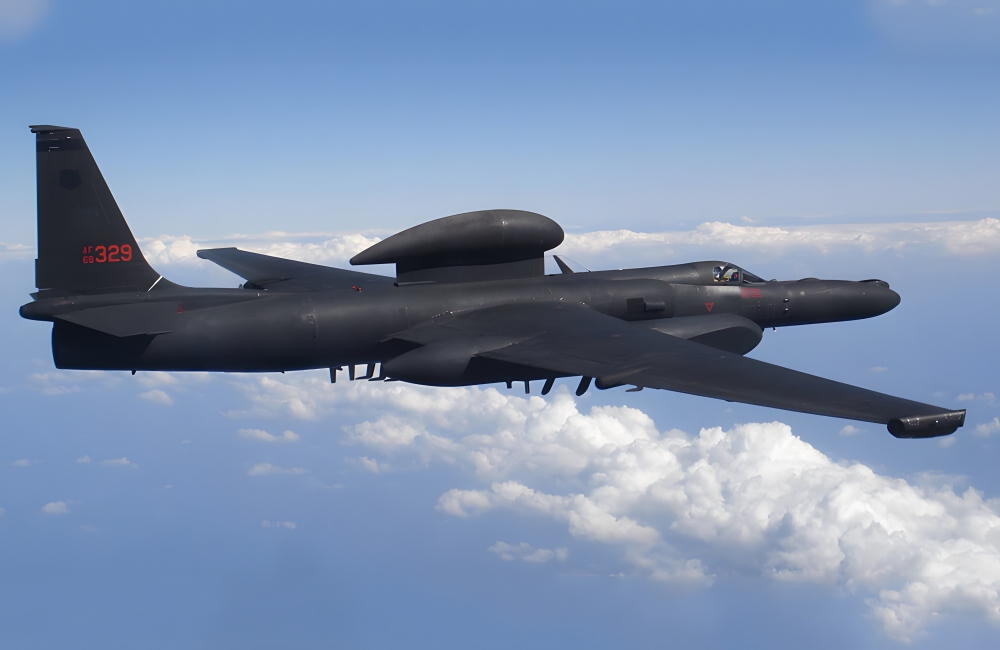
U-2 Dragon Lady @marklanebiz / Twitter.com
Lockheed Martin submitted its original design for the Dragon Lady in 1953. It was introduced shortly after, and it flew during the Cold War over Vietnam, Cuba, China, and the Soviet Union. The Dragon Lady costs an equivalent of $9.1 million per unit today, over 1,000% what it did in 1955.
The reason that the Dragon Lady’s ability to fly at high altitudes was so sought-after and prized during the competition phase was because of the Soviet Union. Soviet fighters, radar, and missiles were three huge concerns during the Cold War. In addition to counter-attacking the equipment, designers had another idea: why not just fly above the Soviets, out of their reach?
12. Boeing T-7 Red Hawk
Entered Service: 2018
Manufacturer: Boeing, Saab Group
Cost: $9.2 billion*
The T-7 Red Hawk, created by Boeing and Saab Group, had its first flight in 2016. The Red Hawk is still in development, and just two have been built for now. It is an advanced trainer. It is designed as a replacement for the T-38 Talon, a Northrop project. Discussions for the Red Hawk’s design were initiated as early as 2003.
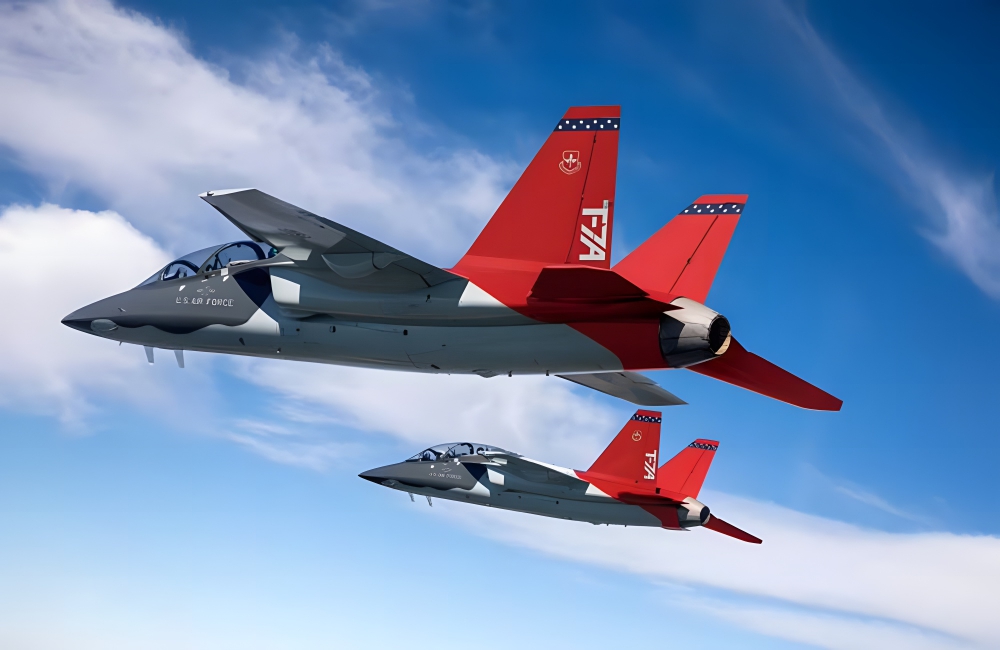
Boeing T-7 Red Hawk @Defence_blog / Twitter.com
The wait has been worth it, and early projections on the Red Hawk show that it is a powerful stealth plane. The Red Hawk name is a tribute to the Tuskegee Airmen, who were known for painting their plane tails bright red.
There have been a few more recent developments of the Red Hawk. Saab announced that it would be opening a factory in the US as part of a partnership with Purdue. The factory would make the T-X. Boeing also announced that it will offer an armed version of the Red Hawk as a replacement for the F-5/Dornier Alpha.
13. TG-16A Glider
Entered Service: 2011
Manufacturer: DG Flugzeugbau
Cost: $4.8 million*
DG Flugzeugbau, a German company, builds this glider. The glider is a member of the two-seater class. The TG-16A is the designation granted to the DG-1000 by the US Air Force. The TG-16A was selected to replace the Blanik TG-10. The TG-16A Glider is a soaring trainer for cadets attending the USAF Academy.
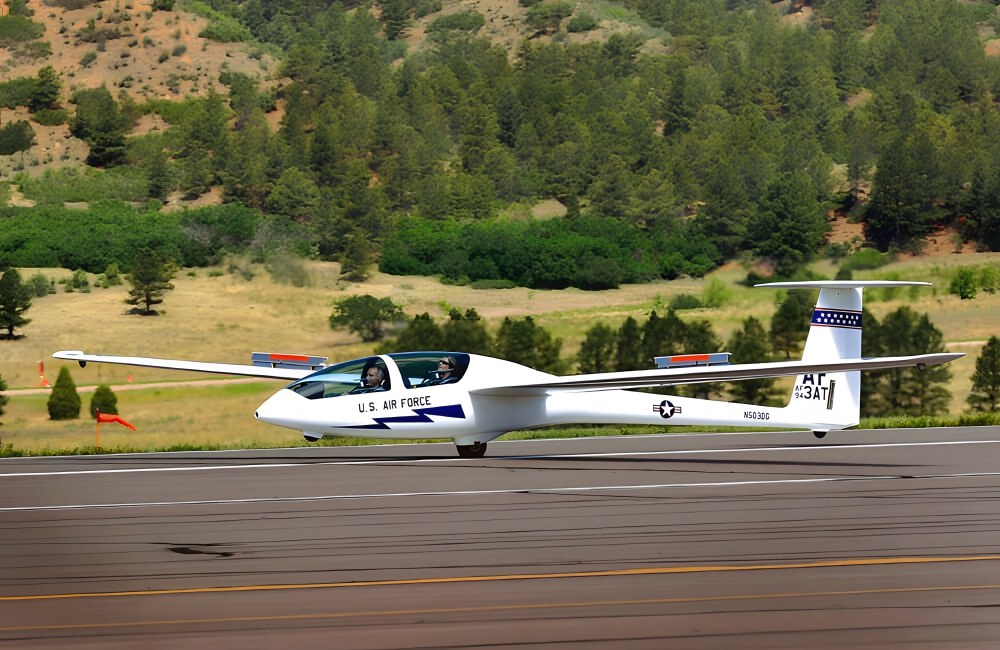
TG-16A Glider @kadonkey / Twitter.com
It is unclear whether American companies like Boeing, Northrop Grumman, or Lockheed Martin submitted proposals for a soaring trainer. Regardless, the TG-16A became part of the Air Force Academy in 2011. It is also the main competition plane for the US Air Force Academy Aerobatic Demonstration Team.
The TG is so well-suited to aerobatics because of its 59-foot span wings. TG-16A plans that have 66-foot span wings are only certified for limited aerobatics. The Engine is a DG1000T, and it is mounted on the double cockpit’s pylon aft. The propeller was both designed and made in a DG factory.
14. Seawolf-class Submarine
Entered Service: 1997
Manufacturer: General Dynamics Electric Boat Division
Cost: $3 billion*
The Navy’s Seawolf-class submarines are a classic unit for the branch. The Seawolf-class of SSNs were first designed in 1983 by General Dynamics Electric Boat. Three are currently active, as the Virginia class succeeded the Seawolf. The building of the Seawolf took place from 1989 until 2005, and they’ve been officially in commission since 1997.
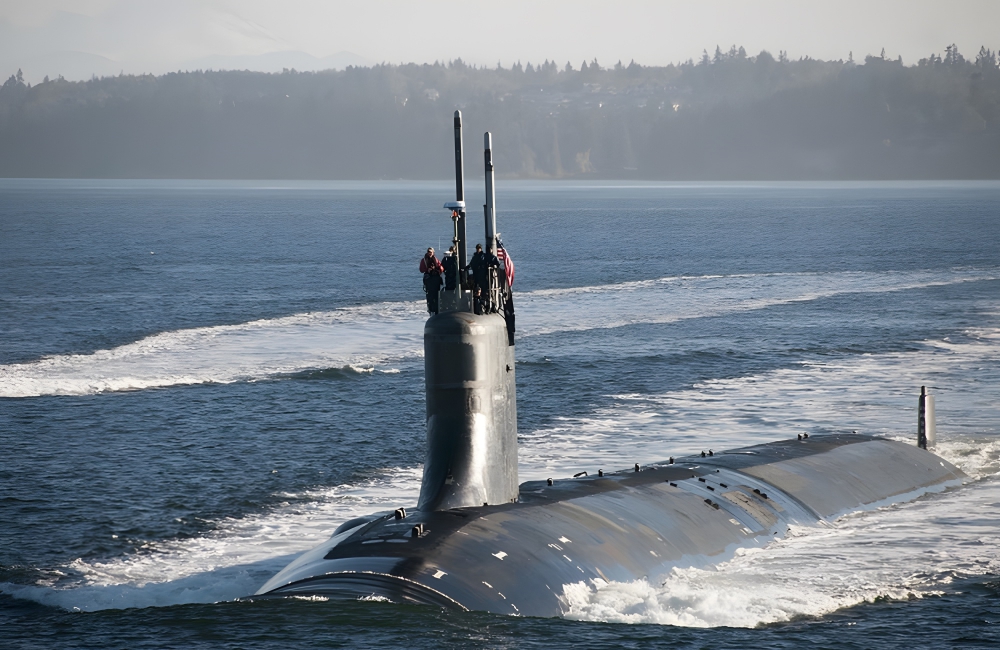
Seawolf-class submarine @ INDOPACOM / Twitter.com
The Seawolfs have unlimited range. Their endurance, as the Navy put it, is limited only by the food supplies on board. Fourteen officers crew these durable SSNs at a time and get a top speed of 35 knots (not silent).
Despite the Seawolf’s endurance, it has a limited fleet. Just three boats are Seawolf-class. The costliness of the Seawolf was the reason that it was so limited in production. Budget constraints after the Cold War were very severe, and the military had to cut back. These limitations led to the smaller Virginia class’ design.
15. RQ-4 Global Hawk
Entered Service: 1998
Manufacturer: Northrop Grumman
Cost: $222.7 million*
Named Tier II+ during its development, the RQ-4 Global Hawk is a remotely-piloted surveillance craft that flies at high altitudes. It was initially designed by Northrop Grumman’s subsidiary, Ryan Aeronautical. The Global Hawk flies duties that are similar to those of the U-2 Dragon Lady. The Northrop Grumman Corp plane provides systematic surveillance using high-res synthetic aperture radar.
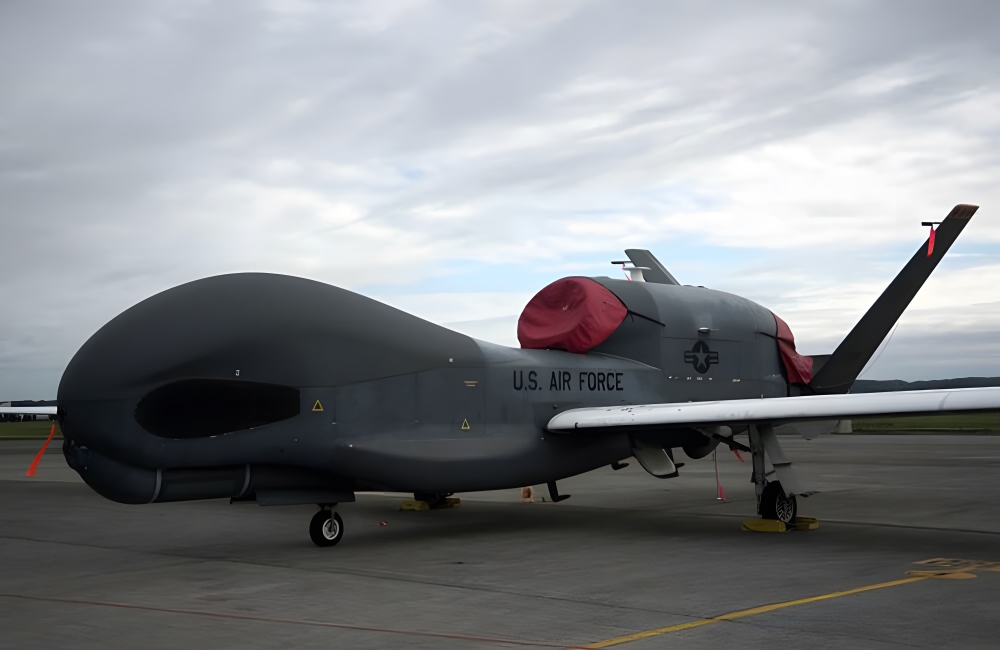
RQ-4 Global Hawk @starsandstripes / Twitter.com
The Global Hawk also uses long-range EO/IR sensors. This plane can survey 40,000 square miles (an area roughly the size of Iceland or South Korea) of terrain in just one day. The total program cost $10 billion. Each unit costs between $131.4 million and $222.7 million when you factor in research and development.
Another cool feature on the RQ-4 is the visible light and infrared imagers. They share a gimballed sensor package. The two use common optics, which allows them to have a telescopic capability. The Global Hawk has an AN/ALR-89 self-protection suite, too, including a laser warning receiver, radar warning receiver, and jamming system.