

3. Quite A Number Of Cosmonauts Have Supposedly Been Lost
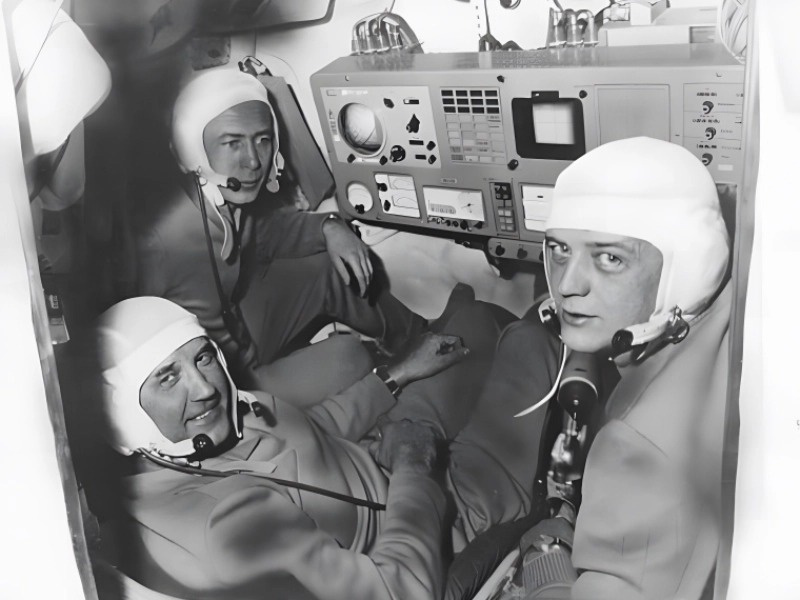
One of the most fierce and significant technical contests in human history is the space race between the Soviet Union and the United States of the 1950s and 1960s. Set against the Cold War, this era saw both countries stretching the boundaries of science and human endurance in their aim of space exploration dominance. Though the Soviet Union celebrated many achievements, including the launch of Sputnik 1 in 1957 and Yuri Gagarin’s first manned flight in 1961, there are ongoing rumours and theories about a darker side to their space program: the claimed cover-up of cosmonaut deaths during early space missions and tests.
Often referred to as the “lost cosmonauts,” these allegedly dead have become the focus of great conjecture and discussion among historians, space enthusiasts, and conspiracy theories. The idea implies that the Soviet Union may have hidden failures and deaths in its space program, therefore deleting these people from official records, in its haste to preserve its image of technological superiority and to guard state secrets.
There are various elements behind the beginnings of these ideas. First of all, the extremely covert character of the Soviet space program throughout the Cold War era produced conditions ready for conjecture. Unlike NASA’s more transparent approach, which frequently carried launches under media coverage, the Soviet program ran behind a cloak of secrecy, celebrating public achievements but seldom acknowledging mistakes.
Second, there were documented cases of the Soviet Union “unpersoning”—that is, changing historical accounts and deleting people from official photos and records—a practice that gave legitimacy to the theory that similar strategies could have been used in the space program.
Two Italian amateur radio operators, the Judica-Cordiglia brothers, are among the most well-known “evidence” sources bolstering the lost cosmonaut theory. Early in the 1960s, they asserted to have intercepted many troubling signals from Soviet space flights. These included what they said of the sound of a cosmonaut suffocating, distress signals from a spacecraft flying away from Earth, and even a female cosmonaut supposedly saying her dying words before burning up on re-entry. Although professionals have generally refutes these assertions and have mostly discounted them, they nonetheless inspire conjecture and form the pillar of missing cosmonaut mythology.
The acknowledged risks and deaths in the Soviet and American space programs provide even another element influencing these beliefs. The very real hazards of space travel were shown by the death of cosmonaut Vladimir Komarov in the Soyuz 1 mission in 1967 and the Apollo 1 fire that claimed three American lives the same year. These accepted catastrophes caused some to wonder whether previous, unrecorded events could have occurred.
Lost cosmonauts also appeal to more general ideas of sacrifice and bravery in the name of scientific progress. Many people find resonance in the theory that there may be unidentified, unacknowledged pioneers who donated their lives in the early days of space exploration, therefore adding a layer of sadness and mystery to the already gripping account of the space race.
But one should approach these ideas with a sceptical eye. Many hitherto secret records have come to light and many former Soviet space program officials have candidly shared their experiences in the years following the demise of the Soviet Union. These sources have exposed fresh details on difficulties and near misses in the Soviet space program, but they have not offered strong proof to substantiate the presence of many missing cosmonauts.
Moreover, even for a state as powerful as the Soviet Union, the logistics of totally eradicating all signs of several failed flights and dead cosmonauts would have been quite difficult. From engineers and technicians to the families of cosmonauts, the quantity of people engaged in the space program would have made such a broad cover-up quite difficult over time.
Having said that, the Soviet space program did suffer fatalities and setbacks not immediately reported to the public. For many years, the Nedelin catastrophe in 1960—a launch pad explosion killing over 100 people—was hidden. Analogously, the death of cosmonaut Valentin Bondarenko during a 1961 training session went unreported until the 1980s. These actual cases of concealment and delayed disclosure have probably helped to explain why missing cosmonaut beliefs endure.
The whole narrative of the early Soviet space program progressively comes into better clarity as we keep discovering and evaluating historical sources. Although it is improbable that there were many unreported cosmonaut deaths, the ongoing obsession with missing cosmonauts reflects the significant influence of the space race on our shared imagination. It reminds us of the great difficulties and hazards early space explorers encountered as well as the intricate interaction of scientific progress, political goals, and public opinion during a turning point in human history.
 zi ang