
10. Nevado del Ruiz: The Volcano That Awakened a Nation
On November 13, 1985, a somewhat minor eruption set off devastating lahars (volcanic mudflows) that destroyed the village of Armero and caused extensive damage in the Chinchiná River basin, therefore garnering worldwide attention. Claiming approximately 23,000 deaths, this disaster ranks second among all the volcanic disasters of the 20th century and the deadliest lahar in recorded history. Armero’s tragedy acted as a wake-up call for Colombia and the international volcanological community, stressing the vital need of rapid evacuation protocols and good danger communication.
Following the 1985 eruption, Colombia greatly improved her capacity for volcano monitoring. Established to track Nevado del Ruiz and other surrounding volcanoes, the Volcanological and Seismological Observatory of Manizales is run by the Colombian Geological Survey. To find early indicators of volcanic activity, this facility uses a wide range of monitoring methods including seismic networks, gas analysers, satellite observations, ground deformation measures.
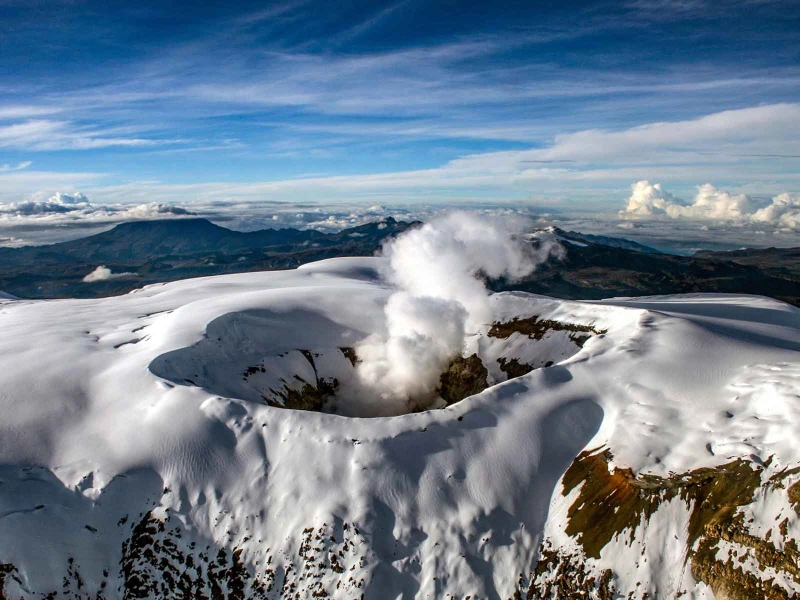
The glaciated top of the volcano adds still another level of difficulty for monitoring and danger analysis. Even in somewhat small eruptive events, the interaction of volcanic heat with the ice cover can cause fast melting and lahars to develop. Glacial retreat brought on by climate change is changing this dynamic and may influence future eruptive activity as well as related dangers.
Nevado del Ruiz is still a volcano that is active; recent years have seen periods of higher activity noted. Local authorities have created thorough emergency response strategies and every event of disturbance is closely watched. Aimed at ensuring that local people are better ready for possible volcanic crises, the lessons learnt from the 1985 disaster have resulted in enhanced early warning systems and community education campaigns.
Though Nevado del Ruiz and its environs have destructive power, their ecological value is very considerable. Unique high-altitude environment found on its upper slopes, the páramo ecosystem is vital for the water control in the surrounding areas. Los Nevados National Natural Park, which guards a varied range of Andean flora and fauna, also includes the volcano.
Nevado del Ruiz research keeps greatly advancing our knowledge of lahar dynamics, volcano-glacier interactions, and successful disaster risk reduction techniques. Researchers looking at the effects of climate change on glaciated volcanoes and the possible consequences for volcanic risks have a natural laboratory right here.
The Armero disaster of 1985 left a legacy that affects volcanic risk control all around. It underlined the need of multidisciplinary methods to volcano monitoring as well as the great need of good communication among authorities, scientists, and at-risk populations. Along with more global collaboration in volcanology and disaster readiness, the catastrophe also resulted in
Nevado del Ruiz now is not just a possible risk but also a profound emblem of resilience and the need of drawing lessons from previous mistakes. Its continuous activity as well as the attempts to track and comprehend it mirror the complicated interaction between human societies and the dynamic forces of our planet. Nevado del Ruiz stays a focal point for scientific study, hazard reduction initiatives, and public education on the power and beauty of Earth’s geological processes as Colombia keeps developing and improving its strategies for living with active volcanoes.
 zi ang