
2. Yellowstone Caldera, USA
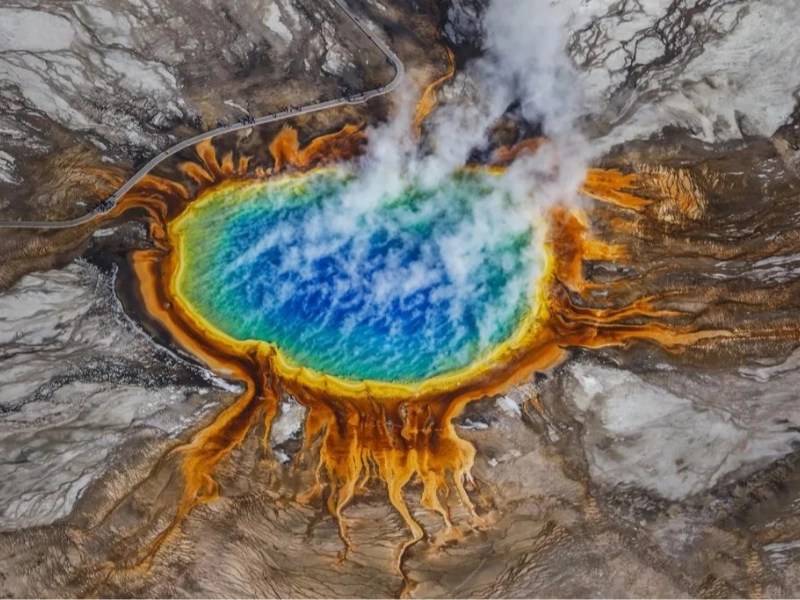
Often known as the Yellowstone Supervolcano, the geological wonder at the core of Yellowstone National Park in western United States is the Yellowstone Caldera. Covering about 3,472 square kilometres, this enormous caldera results from three cataclysmic eruptions over the previous 2.1 million years. About 631,000 years ago, the most recent of these eruptions dumped more than 1,000 cubic kilometres of rock and ash into the atmosphere, drastically changing the surrounding terrain and maybe affecting world climatic patterns.
Yellowstone’s status as an active geological hotspot makes it especially intriguing. Under the famous geysers, hot springs, and fumaroles of the park, sits a massive magma chamber that still drives the geothermal activity of the area. This enormous reservoir of molten rock, said to be roughly 60 kilometres long and 30 kilometres wide, reminds us constantly of the great force latent under the surface of the Earth.
The possibility of future eruptions of the Yellowstone Caldera has fascinated public as well as experts. Although the likelihood of another superecession in the near future is quite low, the effects of such an event would be significant. A VEI 8 eruption at Yellowstone may affect global weather patterns, cover much of North America in ash, and have broad consequences on infrastructure and agriculture all around.
Still, it’s important to remember that Yellowstone’s activity goes beyond catastrophic eruptions. As magma and hydrothermal fluids flow beneath the surface, the park suffers regular ground deformation as well as numerous earthquakes most of which are too tiny for humans to feel. These continuous activities give researchers important information on the behaviour and possible future activity of the caldera.
Yellowstone’s unusual geological characteristics have made it a natural laboratory for research on volcanic systems and effects on nearby ecosystems. Extremophile species that survive in challenging environments abound in the park’s varied thermal features, including the renowned Old Faithful geyser. These species have attracted a lot of study since they provide understanding of the boundaries of life on Earth and maybe on other worlds.
The Yellowstone Caldera reminds us sharply of the dynamic character of our planet and the strong forces sculpting it. Scientists seek to better grasp this geological marvel as research goes on, therefore enhancing our capacity to forecast and get ready for possible volcanic activity not only in Yellowstone but also at like systems all around the planet.
 zi ang