
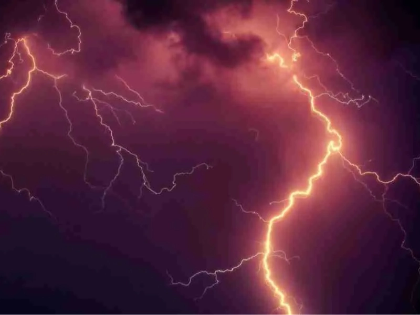
3. Types of Red Lightning Phenomena
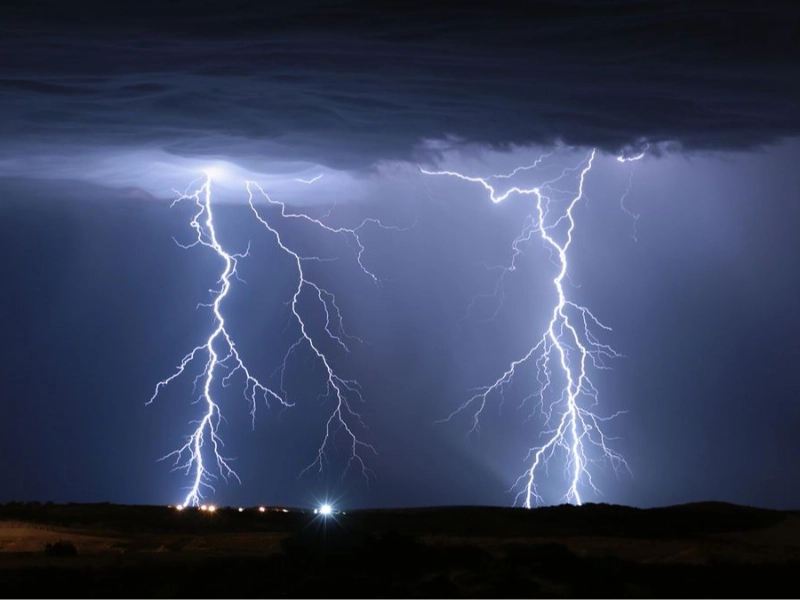
Although the phrase “red lightning” is used generally, there are really several different kinds of high atmospheric visual events falling under this category. Usually found as a cluster of reddish-orange tendrils rising from the top of thunderclouds, the sprite is the most often occurring type. Columnar, carrot-like, or jellyfish-like forms are just a few of the several shapes sprites can adopt. Another kind shows as fast growing rings of red light: the ELVES (Emission of Light and Very Low Frequency Perturbations due to Electromagnetic Pulse Sources). Although these circular events stretch hundreds of km in diameter, they are difficult to see with the unaided eye since they endure just a fraction of a second. Though not red itself, blue jets commonly accompany red sprites and show up as blue cones of light emanating skyward from thundercloud tops. Larger forms of blue jets, giant jets can reach even greater altitudes and occasionally link the ionosphere to the cloud tops. In terms of form, duration, and altitude, every one of these events has special qualities that add to the interesting and complicated realm of high atmospheric electricity. New forms of upper atmospheric discharges, such “gnomes” and “pixies,” are still being found by researchers, thereby broadening our knowledge of the several family of brief luminous occurrences occurring above thunderstorms.
4. The Role of Thunderstorms in Red Lightning Formation
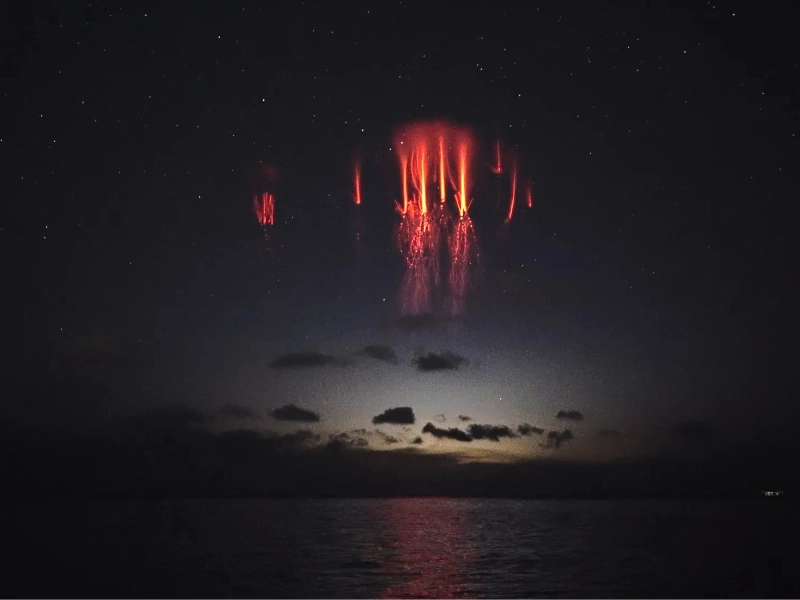
Red lightning is formed in great part from thunderstorms. These atmospheric disturbances produce the required environment for sprites and other higher atmospheric electrical events to occur. Usually, red lightning is connected with very strong thunderstorms, particularly those that generate positive cloud-to- ground lightning strikes. Less often occurring than negative strikes, these positive strikes move a lot of electrical charge from the cloud to the ground. An powerful electromagnetic pulse produced by this abrupt charge spreads upward into the mesosphere. Red sprites and other associated events are produced when this pulse interacts with the rarefied gases in the top atmosphere. The probability and frequency of red lightning events are strongly influenced by the magnitude and intensity of the thunderstorm as well as by its electrical properties. Fascinatingly, not all thunderstorms generate red lightning; the phenomena is more usually seen over big, long-lived storm systems called Mesoscale Convective Systems (MCS). These systems give several chances for the formation of upper atmospheric discharges since they can span hundreds of kilometres and last several hours. The intricate interaction between the lower and higher atmosphere during thunderstorms emphasises the linked character of Earth’s electrical system and the need of research of these events to better grasp the atmospheric dynamics of our planet.
 zi ang