
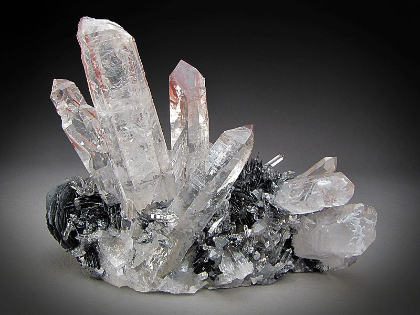
1. Quartz (Silicon Dioxide)
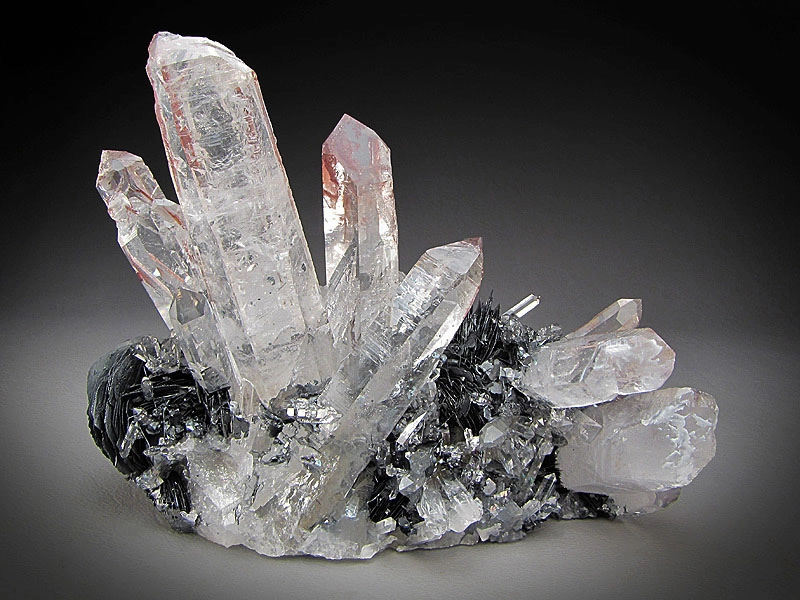
With a chemical formula SiO2, quartz is among the most plentiful and common minerals found in the crust of Earth. Its importance in the field of electronics and technology is almost impossible to overestimate since silicon, the basis of the semiconductor business, is its main raw ingredient. From quartz to silicon wafers, the path is complicated and requires several rounds of purification and improvement. High-purity quartz first melts in an electric arc furnace using carbon to generate metallurgical-grade silicon. Though purer than its mineral form, this silicon nevertheless has contaminants that render it inappropriate for use in electronics. The metallurgical-grade silicon is refined further using techniques include the Siemens process or zone refining to reach the degree of purity needed for semiconductors. These techniques generate electronic-grade silicon with parts per billion measurable amounts of impurities.
Usually by the Czochralski method, single crystal ingots are grown from the purified silicon. This technique produces a big, single-crystal cylindrical ingot by dipping a seed crystal into molten silicon and gradually dragging it higher while spinning. After that, this ingot is cut into thin wafers that provide the basis for microchips, integrated circuits, and other electronic components’ manufacture. Silicon is perfect for these uses because of its extraordinary electrical characteristics, which include semiconducting character and capacity to be precisely doped with other elements. Wide bandgap and thermal stability of silicon enable the design of electronic devices capable of consistent operation in many environments.
Apart from its use as a silicon source, quartz itself finds direct use in electronics. Its piezoelectric characteristics make it important for the manufacturing of resonators, oscillators, and filters applied in different electronic devices. Time circuits, clocks, and watches all use quartz crystals to offer exact frequency control. Quartz oscillators are vital parts in scientific equipment, navigation systems, and telecommunications since their accuracy and stability define them. Optical fibers—which have transformed telecommunications by allowing high-speed, long-distance data transmission—are produced from fused quartz, a high-purity form of silica glass. Furthermore valuable in the creation of specialised laboratory equipment and high-temperature industrial uses connected to electronics production are quartz’s specific characteristics including hardness, chemical inertness, and thermal stability.
 zi ang