
9. The Great Dark Spot on Neptune: A Dynamic Storm in the Outer Solar System
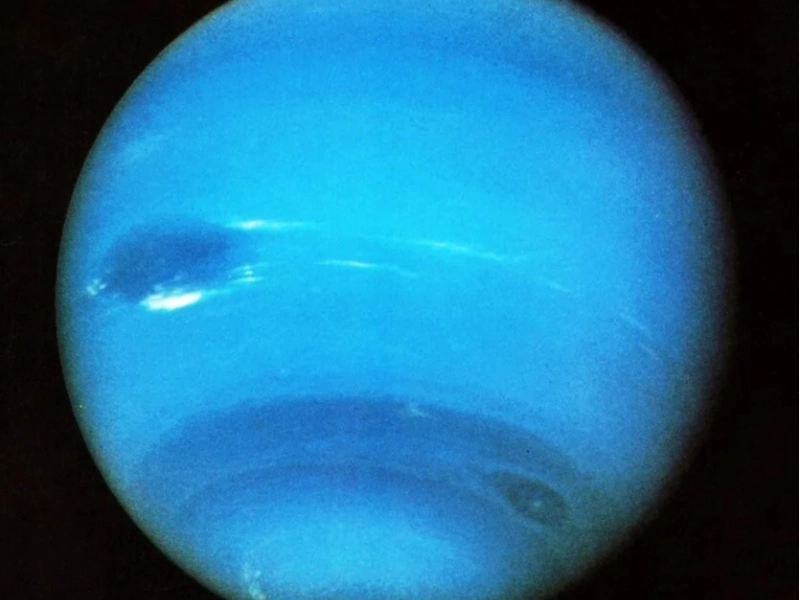
Neptune, the distant ice giant and outermost planet in our solar system, harbors one of the most intriguing atmospheric phenomena known to planetary science: the Great Dark Spot. This massive storm system, reminiscent of Jupiter’s Great Red Spot but with its own unique characteristics, stands as a testament to the dynamic and complex nature of Neptune’s atmosphere. The Great Dark Spot, first observed by NASA’s Voyager 2 spacecraft during its flyby in 1989, has since become an emblem of Neptune’s mysterious and ever-changing face.The Great Dark Spot is an anticyclonic storm, meaning it rotates in a direction opposite to that of the planet’s rotation. When first observed, it spanned an impressive 13,000 kilometers by 6,600 kilometers, comparable in size to Earth itself. This colossal vortex appeared as a dark, oval-shaped feature against the vivid blue background of Neptune’s hydrogen and helium-rich atmosphere. The spot’s darkness is believed to result from the absorption of blue light by methane gas pulled up from lower layers of the atmosphere as the storm rotates.What sets Neptune’s Great Dark Spot apart from similar features on other planets is its remarkable variability and transient nature. Unlike Jupiter’s Great Red Spot, which has persisted for centuries, Neptune’s dark spots appear to form, evolve, and dissipate over much shorter timescales. When the Hubble Space Telescope observed Neptune in 1994, the original Great Dark Spot seen by Voyager 2 had disappeared, only to be replaced by another similar feature in the planet’s northern hemisphere. This dynamic behavior provides a unique opportunity for scientists to study the formation and evolution of large-scale atmospheric phenomena in real-time.The mechanisms driving the formation and maintenance of Neptune’s dark spots are subjects of ongoing research and debate. Scientists believe that these storms are born from instabilities in the planet’s zonal wind flow, which can create vortices that grow and become self-sustaining. The extreme cold temperatures and strong winds in Neptune’s upper atmosphere, which can reach speeds of up to 2,100 kilometers per hour, contribute to the formation and persistence of these massive storm systems.One of the most fascinating aspects of the Great Dark Spot is its interaction with other atmospheric features on Neptune. Observations have revealed bright, high-altitude clouds near the edges of the dark spots, nicknamed “companion clouds.” These clouds are thought to be composed of methane ice crystals and are believed to form as air is forced upward by the storm system, cooling and condensing as it rises. The presence and behavior of these companion clouds provide valuable insights into the vertical structure and dynamics of Neptune’s atmosphere.The study of Neptune’s Great Dark Spot and similar features has significant implications for our understanding of atmospheric dynamics not just on Neptune, but on other planets as well. By comparing the behavior of these storms to those on Jupiter and Saturn, scientists can develop more comprehensive models of how planetary atmospheres function across a wide range of conditions. This comparative approach is crucial for advancing our knowledge of atmospheric physics and improving our ability to predict weather patterns on both extraterrestrial bodies and Earth.Moreover, the transient nature of Neptune’s dark spots raises intriguing questions about the long-term evolution of planetary atmospheres. As we continue to observe these features over decades, we may gain insights into how atmospheric circulation patterns on gas giants can change over time, potentially in response to subtle variations in energy input or internal dynamics.
 zi ang