8. Triton’s Cryovolcanic Geysers: Icy Eruptions in the Outer Solar System
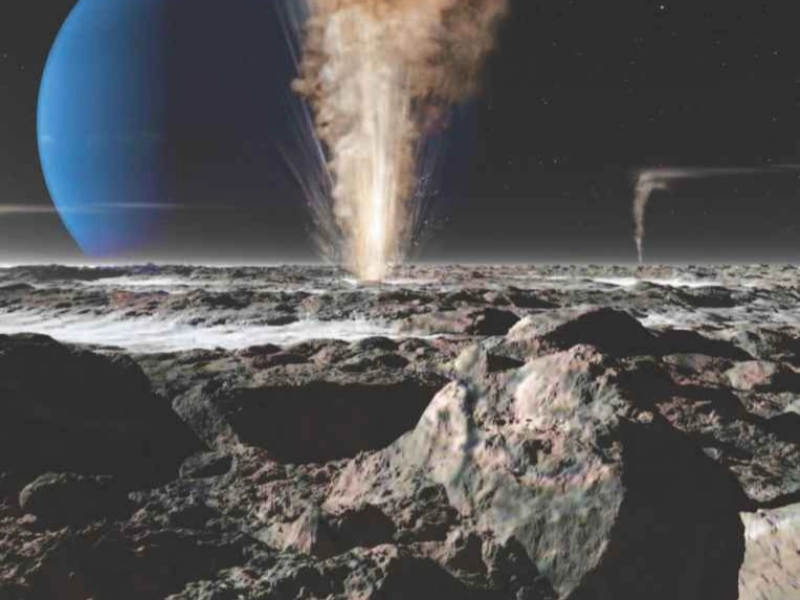
Neptune’s largest moon, Triton, stands as one of the most peculiar and fascinating objects in our solar system. Among its many intriguing features, perhaps none are as captivating as its cryovolcanic geysers. These extraordinary phenomena, which shoot nitrogen gas and dark material into space, represent a unique form of geological activity in one of the coldest known environments in our solar system. The discovery and ongoing study of these geysers have revolutionized our understanding of icy bodies in the outer solar system and their potential for dynamic, ongoing processes.The existence of Triton’s geysers was first revealed during the flyby of NASA’s Voyager 2 spacecraft in 1989. Images captured during this historic encounter showed dark plumes rising up to 8 kilometers above the moon’s surface, trailing for up to 150 kilometers in Neptune’s tenuous atmosphere before dissipating. This observation came as a shock to scientists, who had previously believed that such a distant and frigid world would be geologically dead. Triton, with surface temperatures hovering around -235°C (-391°F), is one of the coldest objects in our solar system, making the presence of active geological processes all the more remarkable.The mechanism behind Triton’s geysers is believed to be a form of cryovolcanism, where instead of molten rock, volatiles such as nitrogen, methane, and water ice play the role of magma. The current leading theory suggests that these eruptions are driven by a greenhouse effect beneath Triton’s translucent nitrogen ice surface. Sunlight penetrates the thin, transparent layer of nitrogen ice and warms the darker material beneath. This warming causes the subsurface nitrogen to sublimate (change directly from solid to gas), building up pressure until it eventually ruptures the overlying ice in explosive geyser-like eruptions.What makes these geysers particularly intriguing is their seasonal nature. Observations suggest that the geyser activity is most pronounced during Triton’s southern summer, when more of its southern hemisphere is exposed to sunlight. This seasonal dependence provides valuable insights into the interplay between Triton’s atmosphere, surface, and subsurface processes. It also raises questions about the long-term evolution of these features and their impact on Triton’s overall geology and atmosphere.The material ejected by Triton’s geysers plays a crucial role in shaping the moon’s surface and atmosphere. The dark, possibly organic-rich material carried aloft by the nitrogen plumes is thought to contribute to the formation of Triton’s polar caps and may be responsible for the moon’s overall reddish-brown coloration. Additionally, these eruptions are likely a significant source of Triton’s tenuous nitrogen atmosphere, constantly replenishing it against losses to space.The discovery of active geysers on Triton has had far-reaching implications for our understanding of the outer solar system. It demonstrated that even in the coldest, most distant reaches of our planetary neighborhood, dynamic geological processes can persist. This realization has prompted scientists to reconsider the potential for activity on other icy bodies, influencing our approach to studying moons like Europa, Enceladus, and even Pluto.Furthermore, Triton’s geysers offer a unique opportunity to study cryovolcanic processes that may be common on other icy worlds but are difficult to observe directly. By understanding the mechanisms driving these eruptions on Triton, scientists can develop models that may apply to similar phenomena elsewhere in the solar system. This knowledge is crucial for assessing the potential habitability of icy moons and for understanding the complex interplay between surface, subsurface, and atmospheric processes on these distant worlds.The study of Triton’s geysers also raises intriguing questions about the moon’s internal structure and energy sources. While the sun plays a role in driving the geyser activity, some scientists speculate that there may be additional internal heat sources contributing to Triton’s geological activity. These could include residual heat from the moon’s formation, tidal heating from its interaction with Neptune, or even the decay of radioactive elements in its core.

 zi ang