7. Venusian Coronae: Enigmatic Crowns of the Morning Star
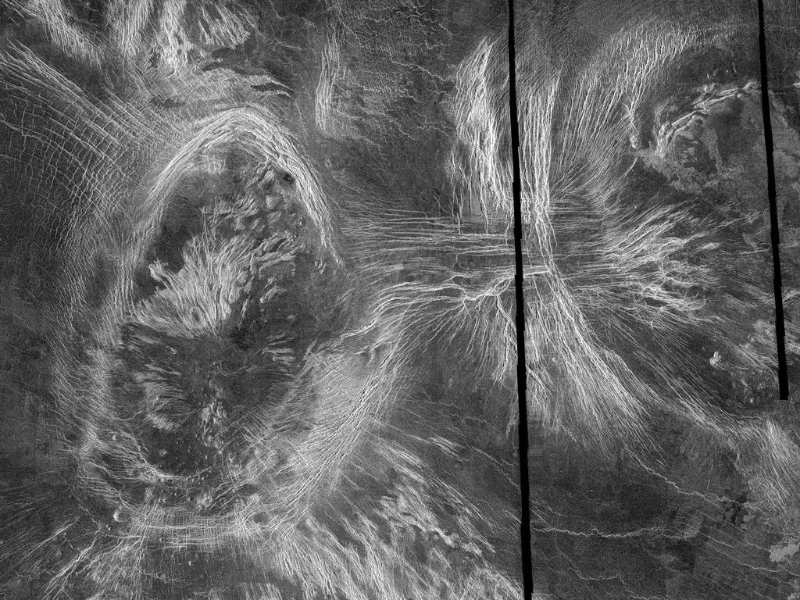
Venus, Earth’s closest planetary neighbor, is a world of extremes and mysteries. Among its most intriguing geological features are the coronae, unique circular to oval-shaped structures that dot the planet’s surface. These formations, whose name is derived from the Latin word for “crown,” are a testament to the complex and dynamic geological processes that have shaped Venus throughout its history. Coronae are unlike any structures found on other terrestrial planets, making them a subject of intense scientific interest and speculation.Coronae on Venus were first identified in radar images sent back by NASA’s Magellan spacecraft in the early 1990s. These structures typically range from about 60 to 800 kilometers in diameter, with some exceptional examples reaching sizes of up to 2,600 kilometers across. They are characterized by a raised rim surrounding a central depression, often accompanied by concentric fractures and radial features extending outward from the center. This distinctive morphology gives many coronae the appearance of a crown or diadem when viewed from above, hence their name.The formation of coronae is believed to be intimately linked to Venus’s internal dynamics and the interaction between the planet’s mantle and crust. The prevailing theory suggests that coronae are the surface expression of mantle plumes – upwellings of hot material from deep within the planet. As these plumes rise and approach the surface, they cause the crust to bulge upward and fracture. Over time, as the plume material spreads out beneath the crust, the central area may subside, creating the characteristic depression surrounded by a raised rim.What makes Venusian coronae particularly fascinating is their diversity in both form and apparent age. Some coronae appear relatively young and may still be actively forming, while others show signs of significant erosion and deformation, suggesting they are much older. This variety provides valuable insights into the geological evolution of Venus over time. Furthermore, the distribution of coronae across the Venusian surface is not uniform, with many concentrated in certain regions, particularly within the planet’s equatorial belt. This pattern may reflect underlying variations in Venus’s mantle dynamics or crustal structure.The study of coronae has significant implications for our understanding of Venus’s internal structure and thermal evolution. Unlike Earth, Venus does not appear to have active plate tectonics, the process that drives much of our planet’s geological activity. Instead, Venus may release its internal heat through a mechanism known as “stagnant lid convection,” where the planet’s thick, rigid crust remains largely intact while convection occurs in the mantle below. Coronae may represent localized areas where this convection interacts most strongly with the surface, providing rare glimpses into the processes occurring deep within Venus.Moreover, the presence and characteristics of coronae offer clues about Venus’s past and potential future. Some scientists have proposed that the formation of coronae may be linked to periods of widespread volcanic activity on Venus, potentially contributing to significant changes in the planet’s climate and surface conditions over time. Understanding these processes could provide insights into Venus’s transformation from a potentially habitable world billions of years ago to the inhospitable planet we see today.

 zi ang