6. Enceladus’ Enigmatic Tiger Stripes: A Window to a Hidden Ocean
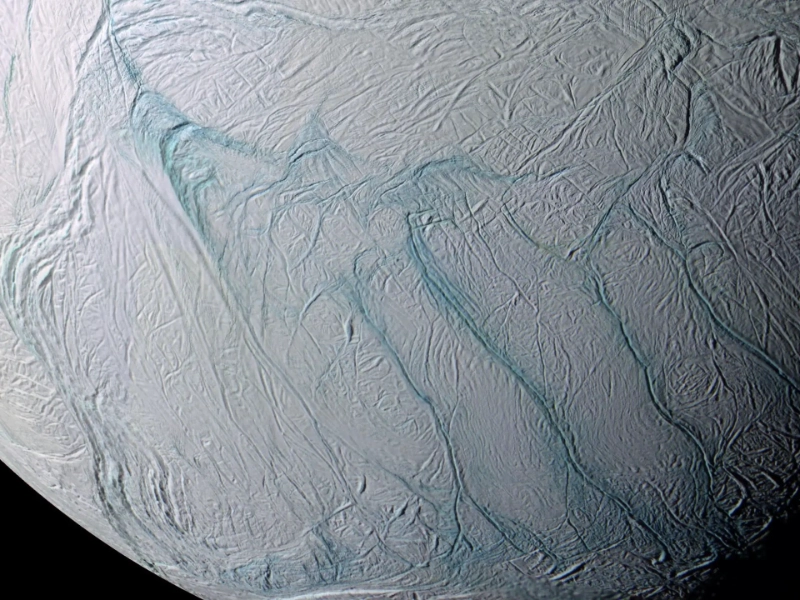
Saturn’s moon Enceladus, despite its relatively small size of only about 500 kilometers in diameter, has emerged as one of the most intriguing bodies in our solar system, largely due to the presence of its distinctive “tiger stripes.” These remarkable features, officially named Alexandria, Cairo, Baghdad, and Damascus Sulci, are a set of four prominent, parallel linear depressions located near the moon’s south pole. Each of these fissures stretches for about 130 kilometers in length, is approximately 2 kilometers wide, and plunges 500 meters deep into the icy crust of Enceladus. What makes these features truly extraordinary is not just their appearance, but their active nature and what they reveal about the moon’s internal structure.The tiger stripes were first observed in high-resolution images captured by NASA’s Cassini spacecraft during its close flybys of Enceladus. These images revealed not only the distinct morphology of the fissures but also something far more surprising: plumes of water vapor and ice particles erupting from these cracks into space. This discovery was nothing short of revolutionary, as it provided compelling evidence for the existence of a subsurface ocean beneath Enceladus’ icy shell. The plumes, which can reach heights of hundreds of kilometers above the surface, are thought to be driven by hydrothermal activity at the bottom of this hidden ocean.The mechanism behind the formation and activity of the tiger stripes is a subject of ongoing scientific investigation and debate. The current leading theory suggests that they are the result of tidal stresses caused by Saturn’s gravitational pull. As Enceladus orbits Saturn, it experiences varying gravitational forces that cause the moon to stretch and compress. This flexing generates heat through friction within the moon’s interior, keeping the subsurface ocean liquid and creating pressure that forces water up through the cracks in the ice shell. The tiger stripes themselves may have formed when the ice shell ruptured due to the pressure of the underlying ocean, with their unique parallel arrangement possibly influenced by the direction of tidal stresses.The composition of the plumes erupting from the tiger stripes has been a subject of intense scientific interest. In addition to water ice and vapor, Cassini’s instruments detected various organic compounds, salts, and silica nanoparticles in the ejected material. The presence of these components, particularly the silica particles, suggests that there is ongoing hydrothermal activity at the ocean floor, similar to the deep-sea hydrothermal vents found on Earth. This discovery has profound implications for the potential habitability of Enceladus, as such environments on Earth are known to support diverse ecosystems even in the absence of sunlight.The tiger stripes and their associated plumes also provide a unique opportunity for sampling and studying the composition of Enceladus’ subsurface ocean without the need for drilling through the ice shell. As the plumes erupt into space, they carry with them material from the ocean below, effectively delivering samples directly to spacecraft flying through them. This has allowed scientists to analyze the chemical makeup of the ocean and search for potential biosignatures that could indicate the presence of life.The discovery and ongoing study of Enceladus’ tiger stripes have revolutionized our understanding of icy moons and greatly expanded the number of potentially habitable environments in our solar system. They demonstrate that even small, seemingly inert bodies can harbor dynamic processes and potentially support the conditions necessary for life. As we continue to explore and unravel the mysteries of Enceladus, the tiger stripes stand as a testament to the surprising complexity and potential of worlds beyond our own, challenging our preconceptions and inspiring future missions to delve deeper into the secrets of this fascinating moon.

 zi ang