5. Io’s Volcanic Inferno: The Most Active World in the Solar System
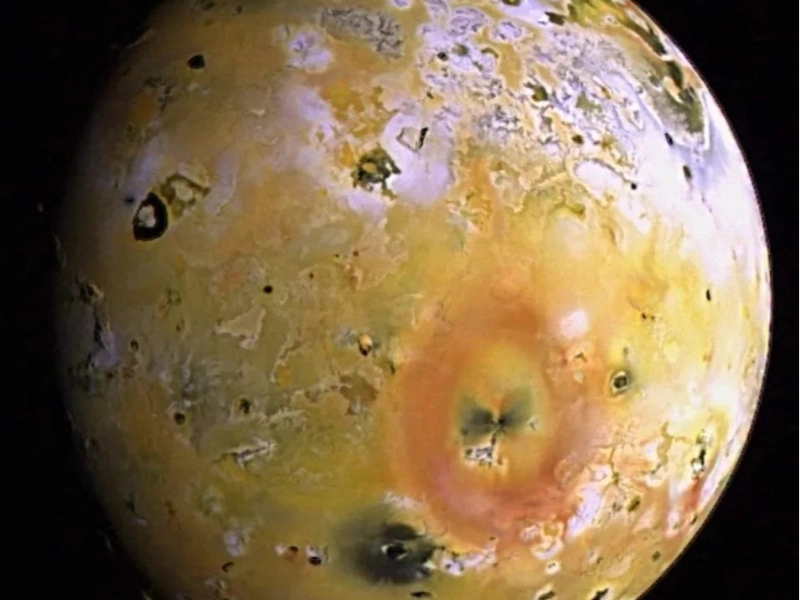
Io, the innermost of Jupiter’s four large Galilean moons, stands out as a celestial anomaly, defying expectations with its intense and ceaseless volcanic activity. This relatively small moon, only slightly larger than Earth’s Moon, holds the distinction of being the most volcanically active body in our entire solar system. Its surface is in a constant state of transformation, reshaped by the relentless eruptions of its numerous volcanoes, which spew forth sulfur, silicate lava, and other materials in spectacular displays of geological fury.The discovery of Io’s volcanic nature came as a surprise to scientists when the Voyager 1 spacecraft captured images of its surface in 1979. What they saw was a world unlike any other: a technicolor landscape dotted with hundreds of volcanic centers, some hurling plumes of material hundreds of kilometers above the surface. Subsequent missions and Earth-based observations have only served to deepen our fascination with this volcanic wonderland, revealing a world where the landscape can change dramatically in a matter of weeks or even days.The source of Io’s incredible volcanic activity lies in its relationship with Jupiter and its fellow Galilean moons. Io is caught in a gravitational tug-of-war between Jupiter and the other moons, particularly Europa and Ganymede. This gravitational interplay causes Io’s orbit to be slightly elliptical, which in turn leads to tremendous tidal forces as it moves closer to and farther from Jupiter. These tidal forces cause Io’s entire body to flex and stretch, much like squeezing a rubber ball. This constant flexing generates an enormous amount of internal heat through friction, which drives the moon’s volcanic activity.The volcanoes on Io are diverse in their nature and behavior. Some produce vast lava flows that can cover hundreds of square kilometers, while others create explosive eruptions that send material soaring into space. The composition of these eruptions is also varied, with some volcanoes producing silicate lavas similar to those found on Earth, while others eject sulfur and sulfur dioxide, creating Io’s characteristic yellow, red, and white coloration. One of the most impressive volcanoes, Loki Patera, is a massive lava lake that regularly overturns, causing brightness variations that can be observed from Earth.The impact of Io’s volcanism extends far beyond the moon itself. The material ejected from its volcanoes contributes to a complex system of interactions within the Jovian system. Some of the ejected particles become ionized and are swept up by Jupiter’s powerful magnetic field, forming a doughnut-shaped ring of plasma around the planet known as the Io plasma torus. This plasma interacts with Jupiter’s magnetosphere, contributing to the planet’s intense auroras and radio emissions.Studying Io’s volcanism provides invaluable insights into planetary geology and the evolution of terrestrial bodies. By observing Io, scientists can witness geological processes occurring on timescales of days or weeks, rather than the millions of years typically required on Earth. This rapid pace of change offers a unique opportunity to study volcanic mechanisms, lava composition, and the interplay between a planet’s interior and surface in real-time.Furthermore, Io serves as a window into the early history of our own planet and other terrestrial bodies in the solar system. The intense volcanic activity we see on Io today may be similar to conditions that existed on Earth, Venus, and Mars billions of years ago when these planets were still releasing large amounts of internal heat. By studying Io, we can gain insights into how volcanic activity shapes a planet’s surface, atmosphere, and potential for habitability.

 zi ang