4. Titan’s Methane Lakes: A Unique Hydrological Cycle
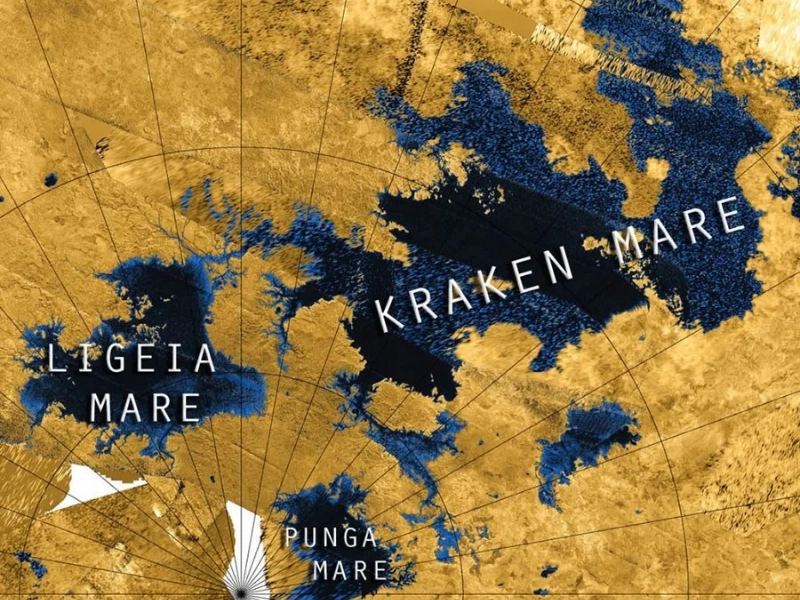
Saturn’s largest moon, Titan, stands out as one of the most extraordinary bodies in our solar system, boasting a feature that makes it remarkably Earth-like in one crucial aspect: it is the only celestial body besides Earth known to have stable liquid on its surface. However, what truly sets Titan apart is the composition of this liquid. Instead of water, Titan’s lakes and seas are filled with liquid hydrocarbons, primarily methane and ethane, creating a unique and alien landscape that has captivated scientists since its discovery.The presence of these hydrocarbon lakes was first confirmed by NASA’s Cassini-Huygens mission, which provided detailed radar and infrared images of Titan’s surface. These observations revealed a complex system of lakes, seas, and river channels, predominantly located in the moon’s polar regions. The largest of these liquid bodies, Kraken Mare, spans an impressive 400,000 square kilometers, roughly five times the size of Lake Superior on Earth. This vast sea, along with other major bodies like Ligeia Mare and Punga Mare, contains a volume of liquid hydrocarbons that potentially exceeds the known oil and gas reserves on Earth.The existence of liquid methane and ethane on Titan’s surface is made possible by the moon’s unique environmental conditions. With surface temperatures averaging around -179°C (-290°F), methane and ethane can exist in liquid form, playing a role similar to that of water in Earth’s hydrological cycle. This Titanian “methanological” cycle involves the evaporation of methane from the surface, the formation of hydrocarbon clouds in the atmosphere, and the subsequent rain of liquid methane back onto the surface. This cycle not only maintains the lakes and seas but also shapes Titan’s landscape through erosion and sediment transport, creating features reminiscent of Earth’s rivers, coastlines, and flood plains.The composition and behavior of Titan’s hydrocarbon lakes present fascinating questions and opportunities for scientific study. For instance, the lakes exhibit intriguing phenomena such as “magic islands” – transient features that appear and disappear in radar images, possibly indicating bubbling, floating, or suspended materials. Additionally, some lakes have been observed to change in size and shape over time, suggesting a dynamic interplay between the surface liquids and Titan’s atmosphere and subsurface.The implications of Titan’s hydrocarbon lakes extend beyond mere geological curiosity. They offer a unique laboratory for studying organic chemistry on a planetary scale, potentially providing insights into the conditions that may have existed on early Earth. The complex organic molecules formed in Titan’s atmosphere and surface liquids could offer clues about prebiotic chemistry and the potential for life to arise in environments radically different from Earth’s.Moreover, Titan’s lakes represent a potential resource for future space exploration. The abundance of hydrocarbons could serve as a fuel source for long-term missions, while the nitrogen-rich atmosphere could potentially be used to produce breathable air. These factors, combined with the relatively low radiation environment compared to other parts of the outer solar system, have led some to propose Titan as a possible site for future human habitation or as a waypoint for deeper space exploration.

 zi ang