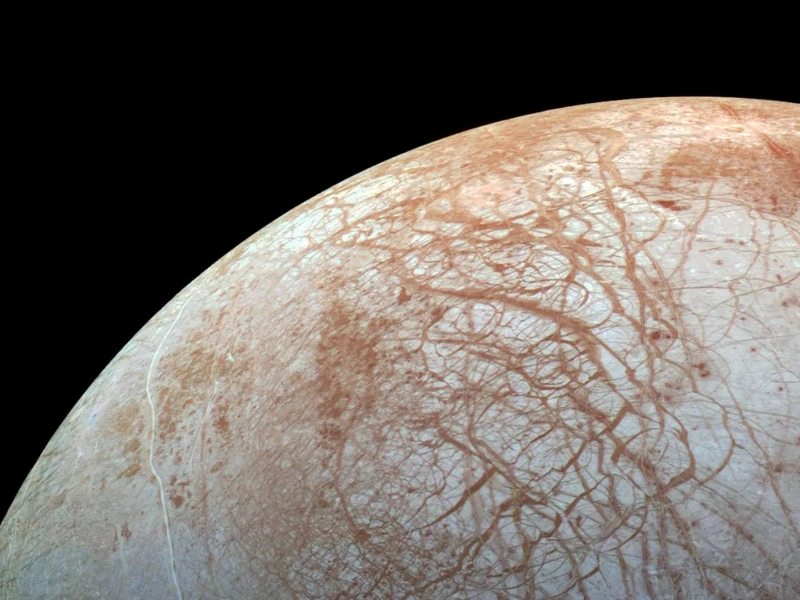
Europa, one of Jupiter’s four largest moons, has long captivated the imagination of scientists and space enthusiasts alike. This icy world, slightly smaller than Earth’s moon, harbors one of the most intriguing features in our solar system: its surface is covered in a layer of ice that conceals a potentially vast subsurface ocean. Among the most fascinating aspects of Europa’s icy shell are the large ice rafts that have been observed on its surface, providing tantalizing evidence of dynamic processes occurring beneath the frozen exterior.These ice rafts, first identified through images captured by NASA’s Galileo spacecraft, appear as large, angular blocks of ice that seem to have broken apart and shifted position relative to one another. The rafts range in size from a few kilometers to tens of kilometers across, creating a complex patchwork pattern across certain regions of Europa’s surface. Their presence and arrangement strongly suggest that Europa’s icy crust is not a static, unchanging layer, but rather a dynamic system that has undergone significant deformation and rearrangement over time.The formation of these ice rafts is believed to be intimately connected to the presence of Europa’s subsurface ocean. Scientists theorize that periodic thinning of the ice shell, possibly due to localized heating from Europa’s interior, can cause sections of the surface to break apart. As these broken sections of ice float on the underlying ocean, they can drift and rotate, much like icebergs on Earth’s oceans. Over time, as the cracks between the rafts refreeze, they create the distinctive patterns observed on Europa’s surface.The implications of these ice rafts extend far beyond mere geological curiosity. Their existence provides compelling evidence for the presence of liquid water beneath Europa’s icy crust, a factor that significantly enhances the moon’s potential habitability. Liquid water is considered one of the key prerequisites for life as we know it, and the possibility of a vast, planet-wide ocean on Europa has made it a prime target in the search for extraterrestrial life within our solar system.Furthermore, the dynamic nature of Europa’s ice shell, as evidenced by these rafts, suggests that there may be mechanisms for material exchange between the surface and the subsurface ocean. This could mean that nutrients and energy sources from the surface, such as compounds created by Jupiter’s intense radiation, might find their way into the ocean below. Conversely, materials from the ocean, potentially including any biological signatures if life exists there, could be transported to the surface through cracks and fissures in the ice.The study of Europa’s ice rafts also provides valuable insights into the moon’s geological history and the processes shaping its surface. By analyzing the patterns and distributions of these features, scientists can reconstruct past movements and changes in the ice shell, offering a window into Europa’s evolution over time. This information is crucial for understanding not only Europa itself but also the broader class of icy worlds that exist in our solar system and beyond.

 zi ang