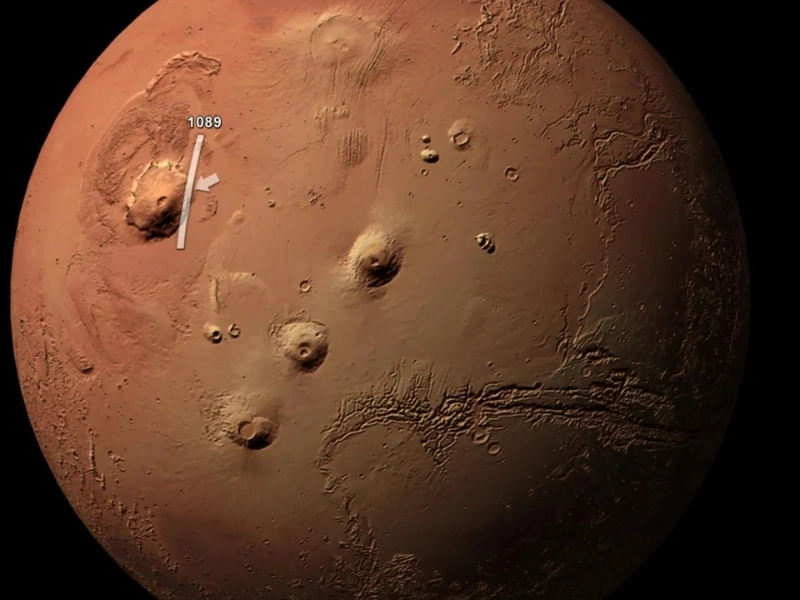
Olympus Mons, the crown jewel of Martian topography, stands as an unparalleled testament to the raw power of volcanic activity in our solar system. This colossal shield volcano, located in Mars’ western hemisphere, holds the distinction of being the tallest known volcano and mountain in the solar system, dwarfing all terrestrial counterparts. Rising to a staggering height of approximately 21.9 kilometers (13.6 miles) above the surrounding plains, Olympus Mons towers nearly three times higher than Earth’s Mount Everest when measured from base to peak. Its sheer magnitude is difficult to comprehend: if placed on Earth, it would rise above the cruising altitude of commercial airliners.The formation of Olympus Mons is a story of persistence and time, spanning billions of years of Martian history. Unlike Earth, where plate tectonics constantly reshape the surface and limit the growth of volcanoes, Mars has been relatively tectonically inactive for much of its history. This lack of plate movement allowed Olympus Mons to grow to its enormous size through countless eruptions from a stationary hotspot. As lava flowed from the volcano’s caldera, it spread out over vast distances, creating a gently sloping shield shape characteristic of such volcanoes. The result is not just a tall peak, but an expansive mountain whose base covers an area roughly the size of Arizona, with a diameter of about 600 kilometers (374 miles).The structure of Olympus Mons provides fascinating insights into Martian geology and the planet’s volcanic processes. Its summit caldera, a complex of overlapping craters, spans approximately 80 kilometers (50 miles) in width, hinting at a long history of eruptions and collapses. The volcano’s flanks are marked by numerous lava flows, some of which may be relatively young in geological terms, possibly less than 2 million years old. This suggests that while Olympus Mons is currently dormant, it may not be entirely extinct. The volcano’s slopes are also characterized by massive cliff-like structures called escarpments, some of which are up to 8 kilometers (5 miles) high. These features are thought to have formed through a combination of landslides, faulting, and the compression of the volcano under its own immense weight.The extreme height of Olympus Mons has significant implications for its environment and potential for exploration. At its peak, the atmospheric pressure is only about 12% of the already thin Martian surface pressure, making it one of the most inhospitable locations on the planet. However, this extreme environment also presents unique opportunities for scientific study. The volcano’s immense size means that its lower slopes experience different climatic conditions than its summit, potentially creating diverse microclimates that could offer insights into Mars’ past and present atmospheric dynamics. Furthermore, the exposed lava flows and other geological features provide a rich record of Mars’ volcanic history, offering clues about the planet’s internal structure and thermal evolution.

 zi ang