Exploring the vast and diverse landscapes of our solar system reveals a tapestry of geologic wonders beyond Earth’s boundaries. From towering volcanoes to mysterious icy landscapes, each planet and moon presents a unique canvas shaped by geological processes that both fascinate and mystify. In this journey through the cosmos, we’ll unveil ten incredible geologic features that redefine our understanding of planetary landscapes. These extraterrestrial marvels, spanning from the scarred surface of Mars to the icy expanses of Saturn’s moons, showcase the dynamic forces at play in our celestial neighborhood. Join us as we embark on a virtual tour, uncovering the geological tapestry that paints the faces of other planets and moons in our cosmic neighborhood.
1. The Majestic Valles Marineris on Mars
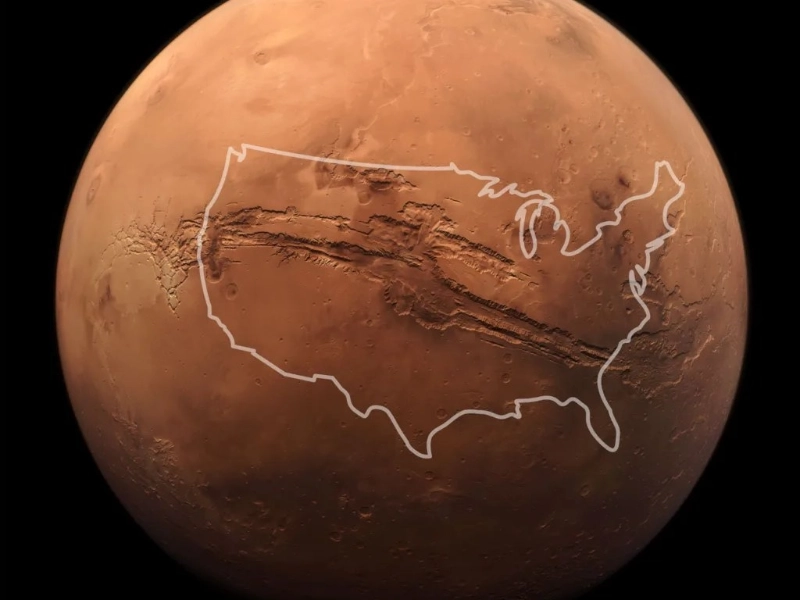
Valles Marineris, a colossal system of canyons stretching across the Martian surface, stands as one of the most awe-inspiring geological features in our solar system. This vast chasm, aptly named after the Mariner 9 spacecraft that first captured images of it in 1971, dwarfs any comparable formation on Earth, including the renowned Grand Canyon. To truly grasp the immense scale of Valles Marineris, one must consider its staggering dimensions: it extends over 4,000 kilometers (2,500 miles) in length, plunges to depths of up to 7 kilometers (4 miles), and in certain locations, spans an impressive width of 200 kilometers (120 miles). These measurements alone fail to convey the true magnificence of this Martian wonder, as its sheer size defies easy comprehension.The formation of Valles Marineris remains a subject of intense scientific debate and research. Unlike Earth’s Grand Canyon, which was primarily carved by the erosive action of the Colorado River over millions of years, the origins of Valles Marineris are believed to be far more complex. Many planetary scientists theorize that its formation was initiated by tectonic processes, specifically the stretching and rifting of the Martian crust. This initial rifting may have been caused by the immense weight of the nearby Tharsis region, a massive volcanic plateau that includes some of the largest volcanoes in the solar system. As the crust stretched and thinned, it created deep fissures that were subsequently widened and deepened by a combination of erosion, landslides, and possibly even the flow of ancient rivers or glaciers.The diverse geological features within Valles Marineris provide a unique window into Mars’ past. Its walls reveal layers of rock that chronicle billions of years of Martian history, offering invaluable insights into the planet’s geological evolution. Scientists have identified various minerals within these layers, including clays and other hydrated minerals, suggesting that water once played a significant role in shaping the canyon system. Moreover, the canyon floor hosts a variety of intriguing features, such as sand dunes, landslide deposits, and even potential salt deposits, each telling its own story about the environmental conditions that have prevailed on Mars over time.The sheer scale of Valles Marineris presents both challenges and opportunities for future Mars exploration. Its vast expanse makes it a daunting target for thorough investigation, yet its potential for scientific discovery is unparalleled. The canyon’s depths may harbor protected environments where traces of past or even present microbial life could potentially be preserved. Additionally, the exposed rock layers provide an unparalleled opportunity to study Mars’ geological history without the need for extensive drilling or excavation. As we continue to explore the Red Planet, Valles Marineris stands as a testament to the dynamic geological processes that have shaped our neighboring worlds, inviting us to unravel its mysteries and expand our understanding of planetary evolution in our solar system.

 zi ang