
5. The Great Blue Hole, Belize
Located in Belize, the Great Blue Hole is considered one of the Top 10 scuba diving sites in the world.
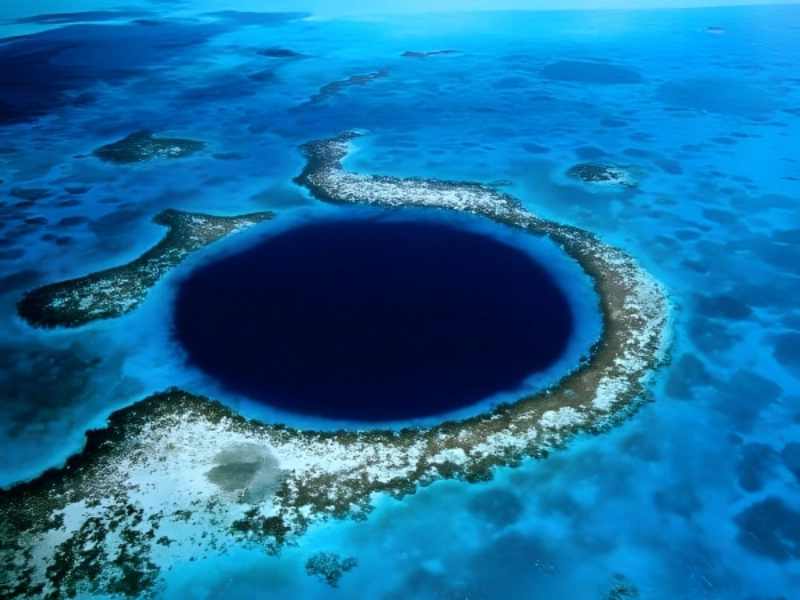
The Great Blue Hole, located off the coast of Belize in the Caribbean Sea, is a natural phenomenon that captivates the imagination of divers, scientists, and nature enthusiasts from around the world. Its designation as “one of the Top 10 scuba diving sites in the world” is well-deserved, as this massive marine sinkhole offers a unique and awe-inspiring underwater experience unlike any other on the planet.
Situated near the center of Lighthouse Reef, about 70 kilometers (43 miles) from the mainland of Belize, the Great Blue Hole is part of the larger Belize Barrier Reef Reserve System, a UNESCO World Heritage Site. From above, it appears as a perfect circular sapphire set in a ring of turquoise, surrounded by the lighter blues and greens of the shallow coral reef. This striking visual has made it one of the most recognizable natural features visible from space.
The formation of the Great Blue Hole is a testament to the Earth’s geological processes. It began as a limestone cave system during the last glacial period when sea levels were much lower. As the ocean rose, the caves flooded and eventually collapsed, creating the circular sinkhole we see today. The hole measures approximately 300 meters (984 feet) across and 124 meters (407 feet) deep, making it the world’s largest natural formation of its kind.
The claim that “Discovery Channel ranked this beautiful place as number 1 on their list of ‘Top 10 Most Amazing Places on Earth'” underscores the Great Blue Hole’s global significance and appeal. This recognition is not just for its beauty but also for its scientific importance. The Blue Hole serves as a time capsule for Earth’s climatic history. Its underwater stalactites and stalagmites, formed when the cave was above sea level, provide valuable data about sea levels and climate conditions dating back tens of thousands of years.
For scuba divers, the Great Blue Hole offers a truly unique experience. The dive typically begins in the shallow waters surrounding the hole, where divers can observe the vibrant coral reef ecosystem teeming with tropical fish. As divers descend into the hole, they enter a different world. The crystal-clear waters near the surface give way to deep, midnight blue as the light fades. At around 40 meters (131 feet), divers encounter a layer of hydrogen sulfide that creates a hazy effect, adding to the otherworldly atmosphere.
The main attractions for divers lie between 30-45 meters (98-148 feet) deep. Here, massive limestone formations create underwater caverns and overhangs. Stalactites, some reaching lengths of 10 meters (33 feet), hang from the cavern ceilings, silent testimonies to the time when this was a dry cave system. The dive is technically challenging due to the depth and the need for careful buoyancy control to avoid disturbing these ancient formations.
Marine life in the Great Blue Hole is distinct from the surrounding reef. While the hole itself doesn’t support as diverse an ecosystem as the shallower waters around it, divers may encounter several species of shark, including nurse sharks and the occasional hammerhead or bull shark. The deeper waters are home to midnight parrotfish, a species unique to the sinkholes of the Lighthouse Reef system.
The Great Blue Hole has been the subject of several high-profile explorations. In 1971, Jacques Cousteau brought his ship, the Calypso, to the site to chart its depths. More recently, in 2018, a team led by Sir Richard Branson and Fabien Cousteau (grandson of Jacques Cousteau) conducted a historic expedition using submarines to create a high-resolution 3D map of the interior, revealing new details about its formation and structure.
While diving is the primary way to experience the Great Blue Hole, it’s also possible to appreciate its beauty from above. Scenic flights offer a bird’s-eye view of this natural wonder, allowing visitors to take in its perfect circular shape and striking color contrast with the surrounding reef. These flights also provide a perspective on the larger atoll system of which the Blue Hole is a part.
The Great Blue Hole’s fame has made it a cornerstone of Belize’s tourism industry, but this popularity also raises concerns about environmental impact. Efforts are being made to balance tourism with conservation. The Belize government has implemented protective measures, including limiting the number of divers and boats allowed in the area, to preserve this unique ecosystem for future generations.
For those unable to dive or fly over the Great Blue Hole, the surrounding Lighthouse Reef Atoll offers plenty of opportunities for snorkeling, kayaking, and observing the rich marine life of the Caribbean. The nearby Half Moon Caye Natural Monument, a protected area known for its population of red-footed boobies and magnificent frigate birds, provides additional attractions for nature lovers.
In conclusion, the Great Blue Hole of Belize is more than just a top diving destination; it’s a natural wonder that offers insights into our planet’s geological history, supports unique marine ecosystems, and provides unparalleled beauty both above and below the water’s surface. Its recognition by the Discovery Channel as the number one amazing place on Earth is a testament to its ability to inspire awe and wonder in all who see it. Whether explored by divers plumbing its depths, scientists studying its formations, or tourists marveling at its perfect circular shape from above, the Great Blue Hole continues to be a source of fascination and discovery, cementing its place as one of the world’s most remarkable natural phenomena.
 zw
zw