
8. Indian Ocean Earthquake and Tsunami (2004)
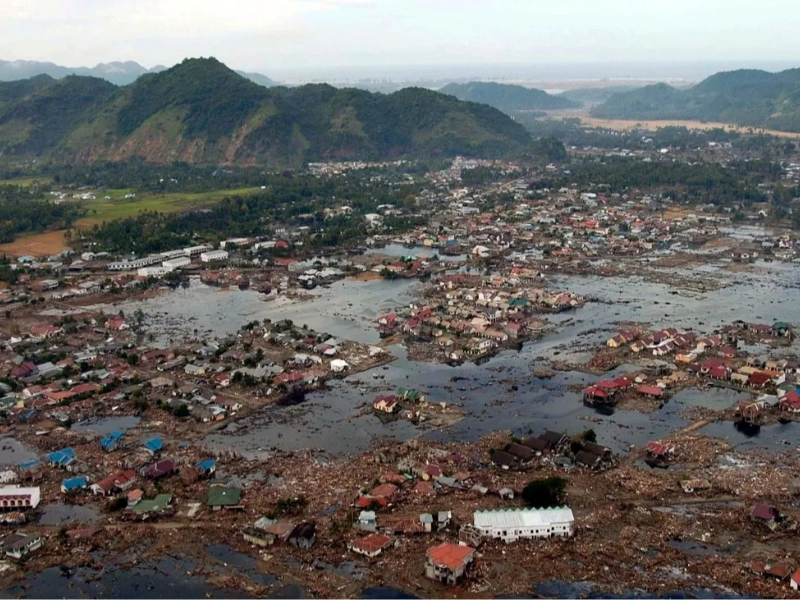
The Indian Ocean Earthquake and Tsunami of December 26, 2004, stands as one of the deadliest natural disasters in recorded history. This catastrophic event, which affected multiple countries bordering the Indian Ocean, not only caused immense loss of life and widespread destruction but also reshaped global perspectives on tsunami risks and disaster preparedness.
The disaster began with a massive undersea megathrust earthquake off the coast of Sumatra, Indonesia. The earthquake, with a magnitude of 9.1-9.3, was the third-largest ever recorded and had the longest duration of faulting ever observed, lasting between 8.3 and 10 minutes. The earthquake itself caused significant damage in northern Sumatra, but it was the subsequent tsunami that led to widespread devastation across the Indian Ocean region.
The tsunami generated by the earthquake produced waves up to 30 meters (100 feet) high in some areas, striking coastlines with little to no warning. The waves traveled at speeds up to 800 km/h (500 mph) across the open ocean, reaching shores as far away as South Africa, some 8,000 kilometers from the epicenter. The countries most severely affected were Indonesia, Sri Lanka, India, and Thailand, but the tsunami also caused significant damage and loss of life in Malaysia, Myanmar, the Maldives, and even on the east coast of Africa in Somalia, Tanzania, and Kenya.
The human toll of the disaster was staggering. An estimated 230,000 people lost their lives across 14 countries, with Indonesia, Sri Lanka, India, and Thailand suffering the highest casualties. Millions more were displaced, having lost their homes, livelihoods, and communities. The scale of the humanitarian crisis was unprecedented, requiring a massive international relief effort.
The 2004 tsunami highlighted critical gaps in the global disaster warning and response systems. At the time, there was no tsunami warning system in the Indian Ocean, despite the region’s vulnerability to such events. The lack of public awareness about tsunami risks in many affected areas contributed to the high death toll, as many people did not know to evacuate to higher ground after feeling the earthquake.
In the aftermath of the disaster, there was a significant global response to address these shortcomings. The Indian Ocean Tsunami Warning System was established, becoming operational in 2006. This system, along with increased public education about tsunami risks and response procedures, has significantly improved the region’s preparedness for future events.
The disaster also led to advancements in tsunami science and monitoring technology. It spurred increased research into tsunami generation, propagation, and coastal impacts. Improved modeling techniques and more sophisticated detection systems have enhanced our ability to predict and respond to tsunami threats globally.
From a humanitarian perspective, the 2004 tsunami prompted a massive international aid response, with billions of dollars pledged for relief and reconstruction efforts. This outpouring of support demonstrated the global community’s capacity for solidarity in the face of disaster, but it also highlighted challenges in coordinating large-scale international aid efforts. The experiences gained from this response have informed subsequent disaster relief operations worldwide.
The long-term recovery process in the affected regions has been complex and multifaceted. While significant progress has been made in rebuilding infrastructure and communities, the disaster’s impacts continue to be felt in many areas. The event has influenced local and national policies on coastal development, disaster preparedness, and environmental management in many of the affected countries.
The 2004 Indian Ocean Tsunami also had broader implications for global disaster risk reduction strategies. It underscored the importance of investing in disaster preparedness and early warning systems, not just in high-risk areas but globally. The event contributed to the development of the Hyogo Framework for Action 2005-2015, a global blueprint for disaster risk reduction efforts.
In the realm of Earth sciences, the 2004 event provided valuable data for understanding the mechanics of large subduction zone earthquakes and their potential to generate destructive tsunamis. It has informed assessments of tsunami risks in other parts of the world, including the Pacific Northwest of North America and the Caribbean.
The Indian Ocean Earthquake and Tsunami of 2004 remains a powerful reminder of the potential for natural disasters to cause catastrophic loss of life and widespread destruction. Its legacy is seen in improved tsunami warning systems, enhanced disaster preparedness measures, and a greater global awareness of the need for coordinated responses to large-scale disasters. As climate change potentially increases the frequency and intensity of some natural hazards, the lessons learned from this event continue to be relevant for building resilience to future catastrophes.
 zi ang