

7. Dust Bowl (1930s)
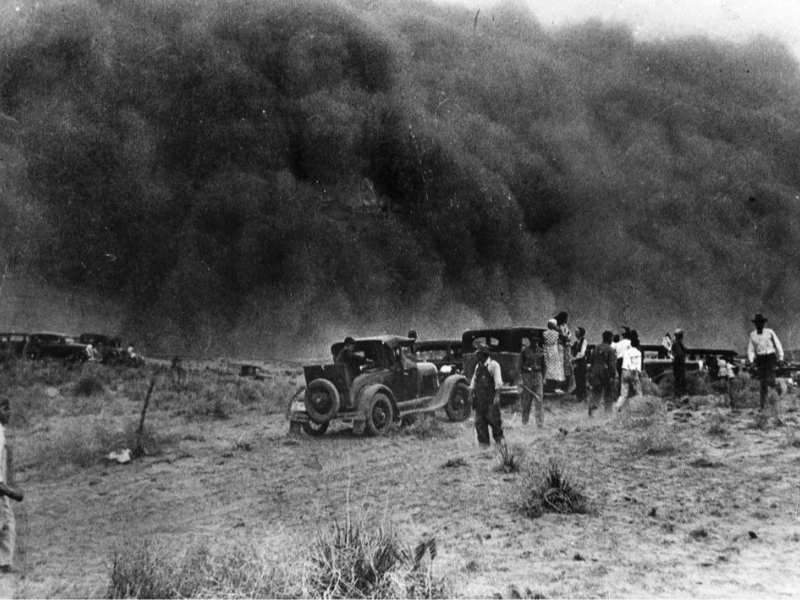
The Dust Bowl of the 1930s stands as one of the most severe environmental disasters in American history, profoundly impacting the social, economic, and agricultural landscape of the United States. This catastrophic event, which affected vast areas of the Great Plains, was a complex interplay of severe drought conditions and poor land management practices, resulting in widespread ecological damage, economic hardship, and forced migrations.
The Dust Bowl period, roughly spanning from 1930 to 1940, was characterized by severe dust storms that ravaged the plains of Kansas, Oklahoma, Texas, New Mexico, and Colorado. These storms, known as “black blizzards” or “black rollers,” could darken the sky for days, depositing layers of dust that buried homes, killed livestock, and devastated crops. The largest of these storms carried Great Plains topsoil as far as New York City and Washington, D.C., dramatically illustrating the scale of the ecological disaster unfolding in America’s heartland.
The roots of the Dust Bowl lay in a combination of natural and human factors. The 1920s had seen a period of unusual wetness in the Great Plains, encouraging farmers to adopt aggressive cultivation techniques and expand into marginal lands. The plowing up of millions of acres of native grassland, which had evolved to withstand the region’s periodic droughts, left the soil exposed and vulnerable. When severe drought conditions hit in the 1930s, coinciding with the Great Depression, the stage was set for an unprecedented environmental catastrophe.
The human toll of the Dust Bowl was immense. Crop failures were widespread, leading to severe economic hardship for farming communities already struggling with the effects of the Great Depression. Many farmers and tenants were forced to abandon their lands, unable to pay mortgages or make a living from the dust-ravaged fields. This led to one of the largest internal migrations in U.S. history, with an estimated 2.5 million people leaving the Plains states, many heading to California and other western states in search of work and a better life. John Steinbeck’s novel “The Grapes of Wrath” vividly portrayed the plight of these “Okies” and “Arkies,” bringing national attention to their struggles.
The Dust Bowl had profound and lasting impacts on American agriculture and environmental policy. It highlighted the dangers of unsustainable farming practices and the need for soil conservation. In response, the federal government, under President Franklin D. Roosevelt’s New Deal, initiated a range of programs aimed at addressing the crisis. The Soil Conservation Service (now the Natural Resources Conservation Service) was established to promote farming practices that would prevent soil erosion. Programs were implemented to retire marginal lands from production, and farmers were educated on techniques such as contour plowing, strip cropping, and crop rotation to preserve soil quality.
The crisis also spurred technological innovations in agriculture. The development of drought-resistant crops, improved irrigation techniques, and the increased use of tractors and other mechanized farm equipment were all accelerated by the challenges posed by the Dust Bowl. These advancements would go on to significantly increase agricultural productivity in the post-war years.
From a social and cultural perspective, the Dust Bowl left an indelible mark on American society. It became a powerful symbol of human struggle against nature and economic adversity. The period inspired a wealth of literature, music, and art, from Woody Guthrie’s folk songs to the stark photographs of Dorothea Lange, which continue to shape our understanding of this era.
The Dust Bowl also had significant political ramifications. It underscored the need for government intervention in times of environmental and economic crisis, helping to solidify support for New Deal programs. The event contributed to changing perceptions about the role of government in environmental stewardship and agricultural policy, laying groundwork for future environmental legislation.
In the long term, the Dust Bowl led to a greater understanding of the relationship between human activities and environmental sustainability. It demonstrated the potential for human actions to dramatically alter ecosystems and highlighted the importance of sustainable land management practices. These lessons continue to be relevant today, as we face global challenges related to climate change, soil degradation, and food security.
The legacy of the Dust Bowl extends far beyond its immediate impact in the 1930s. It serves as a cautionary tale about the consequences of unsustainable agricultural practices and the vulnerability of human societies to environmental change. At the same time, it stands as a testament to human resilience and adaptability in the face of extreme adversity. The responses to the Dust Bowl — in terms of policy, technology, and social adaptation — continue to influence how we approach environmental challenges and agricultural sustainability in the 21st century.
 zi ang