
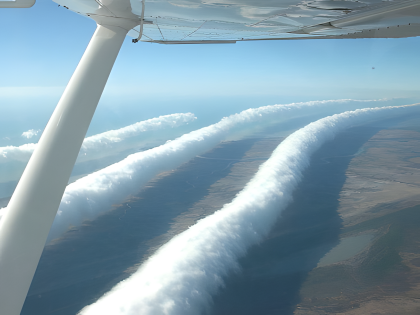
3. Atmospheric Conditions Conducive to Gravity Wave Formation
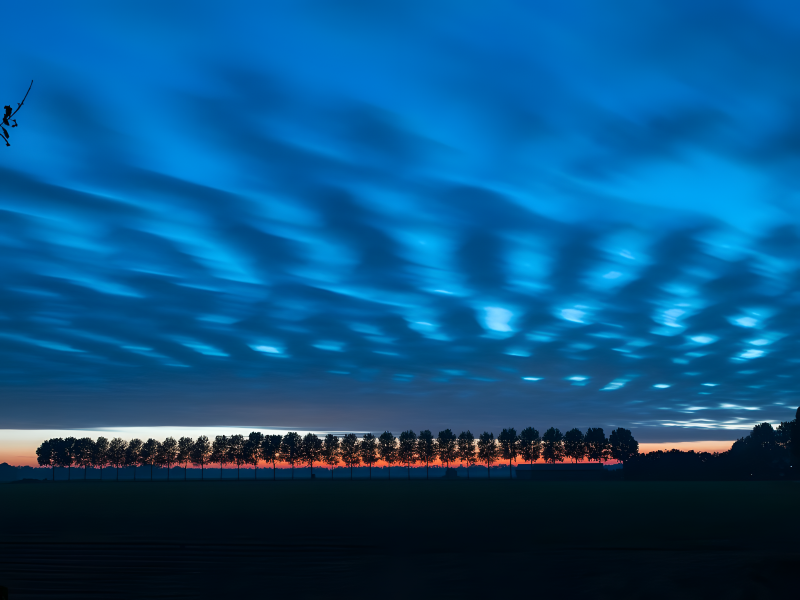
Gravity waves in the atmosphere must be formed under particular conditions to align and produce a delicate equilibrium allowing these amazing occurrences. One of the most often occurring situations for the generation of gravity waves is steady air over steep terrain. The topography’s force upward of the air generates a disturbance capable of spreading as a gravity wave. Under the appropriate conditions, this phenomena—known as mountain wave or lee wave—can span hundreds of kilometres downwind of the mountain range and produce a sequence of standing waves in the atmosphere that can last hours or even days.
Strong temperature inversions are yet another favourable environment for the development of gravity waves. A stable stratification in the atmosphere results from an inversion—that is, from a layer of warm air atop a layer of cooler air. By serving as a waveguide, this steady layering lets gravity waves travel horizontally across great distances. Often linked with high-pressure systems, inversions can be especially widespread in winter or in places like valleys or coastal areas impacted by cool sea air.
Gravity waves can also be produced by atmospheric fronts—where two air masses with different densities and temperatures interact. Unstable interactions between these air masses can produce wave-like disturbances spreading across the atmosphere. Strong convective activity—that linked with thunderstorms or extreme heating of the Earth’s surface—can also produce gravity waves by means of strong updrafts that perturb the surrounding air. These convectively produced waves can be rather important in moving momentum and energy within the atmosphere, so affecting local as well as more general weather patterns.
4. The Role of Gravity Waves in Weather and Climate
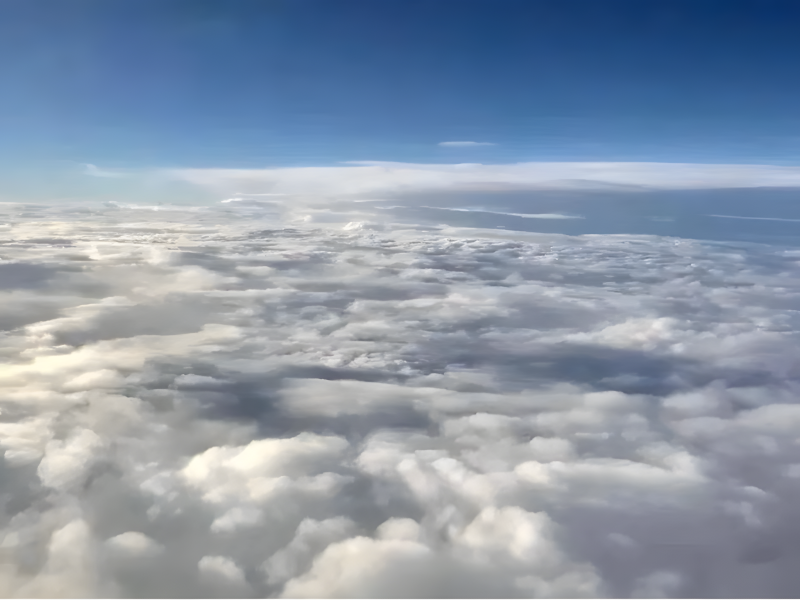
In the dynamics of Earth’s atmosphere, gravity waves are absolutely important; they affect long-term climate trends as well as weather patterns. From the troposphere up to the mesosphere and beyond, these waves serve as a mechanism for distributing momentum and energy over several levels of the atmosphere. Along with affecting the general atmospheric circulation, this energy transfer can have major effects on local and worldwide weather systems.
The way that gravity waves affect cloud development and precipitation is among their most obvious consequences on weather. Gravity waves can produce zones of uplifting and subsidence as they travel over the atmosphere. In areas of uplift, air is pushed to rise, possibly resulting in the development of clouds and, given certain conditions, precipitation. On the other hand, in areas of subsidence the air sinks, which might prevent cloud development and result in brighter heavens. Visible from the ground and from satellite images, this wave-induced pattern of cloud development and dissipation can produce characteristic banded cloud patterns.
The movement of heat and moisture between several levels of the atmosphere depends also on gravity waves. These vertical-traveling waves can carry water vapour and energy from lower atmospheric levels to greater altitudes. This vertical mixing can have major effects on temperature distributions and humidity levels over the atmospheric column, therefore affecting the stability of the atmosphere and the possibility of severe weather development.
Within the field of climate science, global atmospheric circulation patterns are known to be influenced in significant part by gravity waves. Strong, narrow bands of strong wind in the higher layers of the atmosphere that significantly guide weather systems, jet streams, can be influenced by these waves in both strength and position. Gravity waves can indirectly distribute heat and moisture around the world by changing jet stream behaviour, therefore impacting long-term climate patterns and variability.
 zi ang