
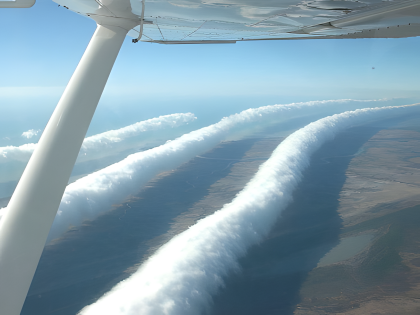
An amazing meteorological phenomena, gravity waves in the atmosphere produce breathtaking, wave-like cloud formations in the sky. Usually confused with unexpected weather events, these captivating patterns are the product of intricate atmospheric dynamics. Dealing with their effects on weather and aviation, this article investigates the science underlying gravity waves, their generation, and the amazing visual spectacle they provide in our heavens.
1. The Science Behind Gravity Waves
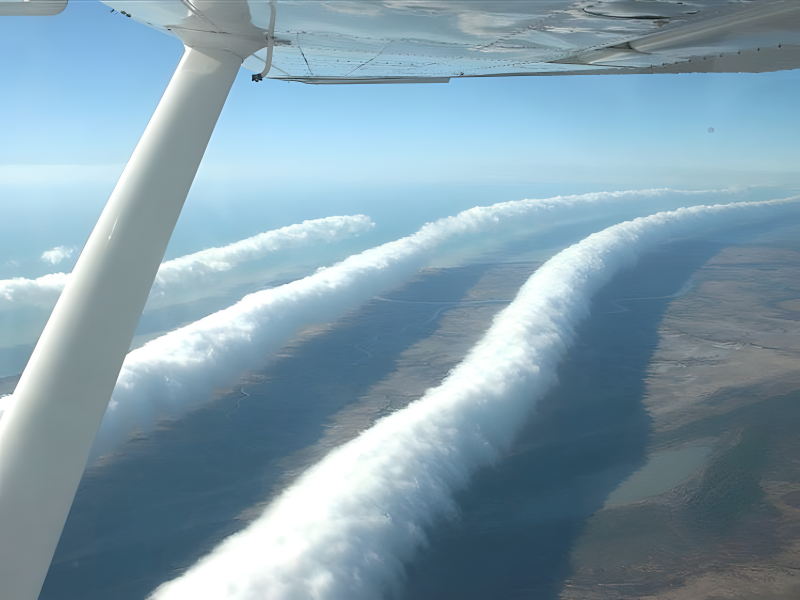
When gravity tries to bring a displaced parcel of fluid back into equilibrium, oscillations known as gravity waves—also called buoyancy waves—occur in a fluid media. These waves show up in the skies as undulating patterns in cloud formations, producing an amazing show that enthrals viewers all over. The process starts when an air parcel is vertically displaced—perhaps by convective activity or across a mountain range. The package cools and denser than its surrounds as it climbs. Then gravity drags this denser air back down, but its momentum causes it to overreach its starting point. Sometimes spanning hundreds of kilometres, this up-and-down motion generates a wave-like pattern capable of spreading into the atmosphere.
Principles of fluid dynamics and atmospheric physics control the creation of gravity waves. Whether gravity waves may develop and spread depends critically on the Brunt-Väisälä frequency, a gauge of atmospheric stability. This frequency enables the oscillation of air parcels in a stable atmosphere, hence producing wave patterns. Among several elements, including the power of the initial disturbance, wind shear, and atmospheric conditions, these waves’ wavelength and amplitude change. These elements interact to produce a sophisticated interaction of forces that produces the varied spectrum of gravity wave events seen in nature.
Knowing gravity waves has practical consequences for aviation and weather forecasting in addition to piques scholarly curiosity. These waves can affect local temperature patterns, generate turbulence for aircraft, and even change the way atmospheric contaminants are distributed. By means of advanced models and observational methods, meteorologists and atmospheric scientists investigate and anticipate the occurrence of gravity waves, therefore improving our capacity to grasp and project atmospheric behaviour. Forecasters can better estimate local weather patterns and possible aviation dangers by including gravity wave dynamics into weather models, therefore helping to provide safer and more effective air transport.
2. The Visual Spectacle of Wave Clouds
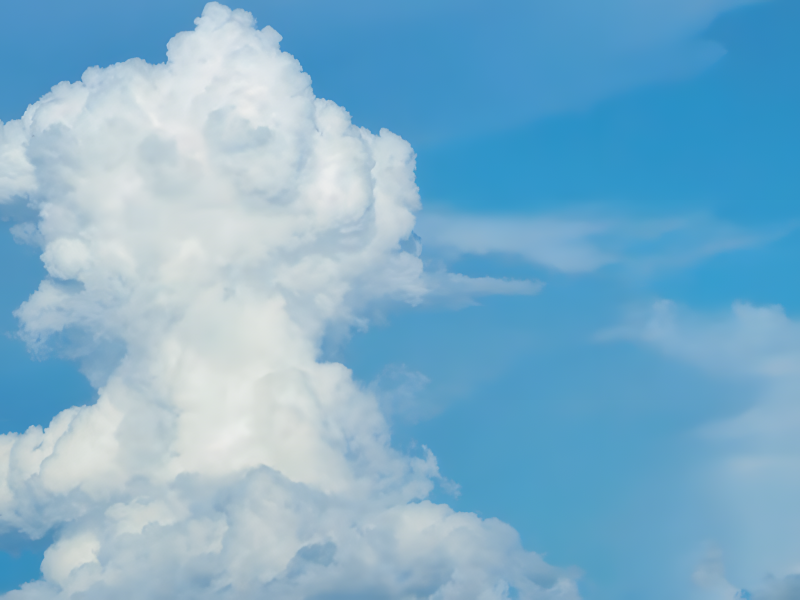
The visual expression of atmospheric gravity waves—that of wave clouds—is what most fascinates about them. Often referred to as undulatus or wave clouds, these clouds form an amazing show in the heavens that mimics ripples on a pond or the ridges of a sandy desert. When the oscillating air parcels approach the dew point, water vapour condenses into obvious cloud droplets and these clouds form. A range of cloud patterns can arise from this process, each with special visual attractiveness and features.
There are several shapes for wave clouds, each providing a unique and amazing show. For example, at mid-levels of the atmosphere Altocumulus undulatus shows as parallel bands or rows of clouds. Often with a fish-scale look, these clouds can span large portions of the sky and provide a rippling image that seems to defy the ordinary randomness of cloud formation. Another kind, also referred to as Kelvin-Helmholtz clouds, arises from notable wind shear between two strata of air. With their unique curl patterns that can be both dramatic and fleeting, these clouds seem to be breaking ocean waves preserved in time.
Wave clouds are a popular topic for photographers and sky watchers all over because of their aesthetic attractiveness. Often heightened by the movement of light and shadow, their consistent, recurring patterns produce a sense of rhythm in the heavens. These clouds can create amazing colours that span gentle pastels to strong, flaming tones during sunrise or sunset, therefore transforming the sky into a painting of vivid colours. For both casual viewers and weather aficionados, observing some wave cloud formations is an exciting experience due in part to their rarity and transitory character. Many have described seeing wave clouds as a mystical experience, a link to the great powers of nature forming our environment.
 zi ang