
10. Tsingy de Bemaraha National Park (Madagascar)
Millions of years of intricate geological processes have produced the tsingy formations in the park. Their construction started about 200 million years ago when the area sank into a shallow sea. Layers of limestone sediment gathered on the seafloor throughout time, finally creating a huge limestone plateau. This plateau was raised above sea level by geological forces, which exposed it to the elements and set the stage for the spectacular erosion that would define the tsingy.
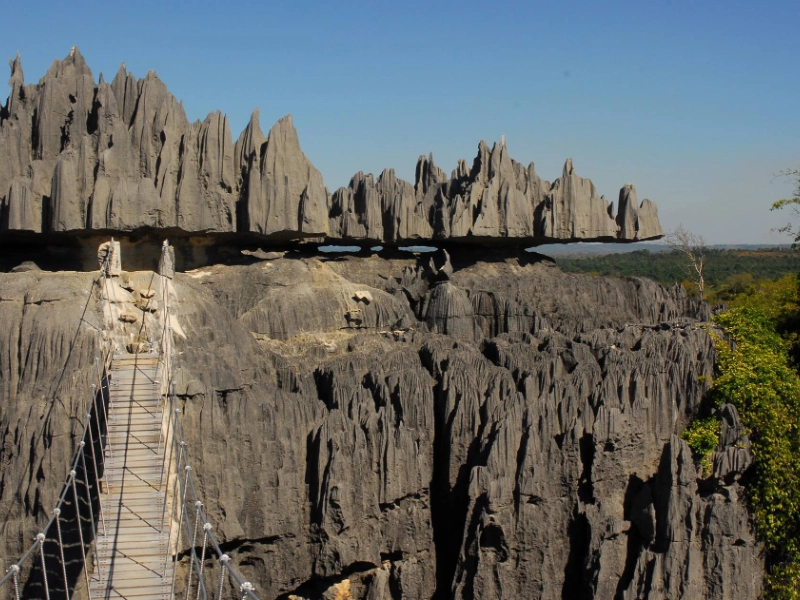
Rainwater, which is somewhat acidic, slowly eroded the limestone over millions of years to create deep fissures, gorges, and razor-sharp pinnacles. This process, sometimes referred to as karst erosion, has shaped the terrain into a large swath of limestone needles. Rising to heights of up to 50 meters (164 feet), these pinnacles form a stone forest visible from all directions. The outcome is an almost alien looking strange and amazing scene.
Tsingy de Bemaraha’s unusual geology has produced a range of microclimates and habitats, therefore promoting a great variety of plant and animal life. Many native species found in the area have evolved to live among the jagged limestone outcrops. Along with several bat species that sleep in the many caverns and crevices, these comprise multiple kinds of lemurs, including the fat-tailed dwarf lemur and the Decken’s sifaka.
The park boasts equally varied and specialised flora. Plants have evolved to thrive in the little soil available in tsingy cracks and fissures. Among the numerous kinds of baobab trees and aloes, many species are native to the park. The visual scene is remarkable when one contrasts the patches of rich greenery with the austere, grey limestone.
Discovering Tsingy de Bemaraha National Park is a demanding but worthwhile adventure. Moving across the tsingy calls for negotiating a system of ladders, suspension bridges, and little paths. To let guests safely explore this difficult terrain, the park has created a set of via ferrata routes—protected climbing paths. These paths present amazing views and a different viewpoint on the tsingy formations.
Other geological marvels abound in the area as well: deep gorges, caverns, and subterranean rivers. Cutting through the southern portion of the park, the Manambolo River produces a breathtaking gorge open for canoe exploration. The terrain has been greatly shaped by this river system, which also still affects the ecology of the park.
Apart from a geological marvel, Tsingy de Bemaraha National Park has cultural value for the nearby Malagasy people. For millennia, people have lived in this area; the park has remnants of human activity including old burial sites. Local people still reside in the surroundings, and the preservation of this special ecosystem depends much on their traditional knowledge and methods.
Among the various conservation issues the park confronts are habitat degradation brought on by nearby agricultural encroachment and deforestation. Another worry is climate change, which might upset the park’s delicate equilibrium of ecosystems. Local people are involved in sustainable tourist development and conservation projects aiming at safeguarding this special environment and its biodiversity.
Tsingy de Bemaraha National Park is evidence of the amazing variety of the landscapes on Earth and the intricate interaction among geology, temperature, and life. Its jagged pinnacles, secret cavernues, and varied ecosystems challenge our ideas of what environments might be and serve as a reminder of the beauties still found in the natural world.
 zi ang