
6. Lake Hillier, Australian territory
Alright, you probably want to know why this lake is pink. Like you are, we were quite fascinated. Here’s a fascinating information for you: Although the exact origin of the colour is yet unknown, experts think red halophilic bacteria found in the salt crust is responsible!
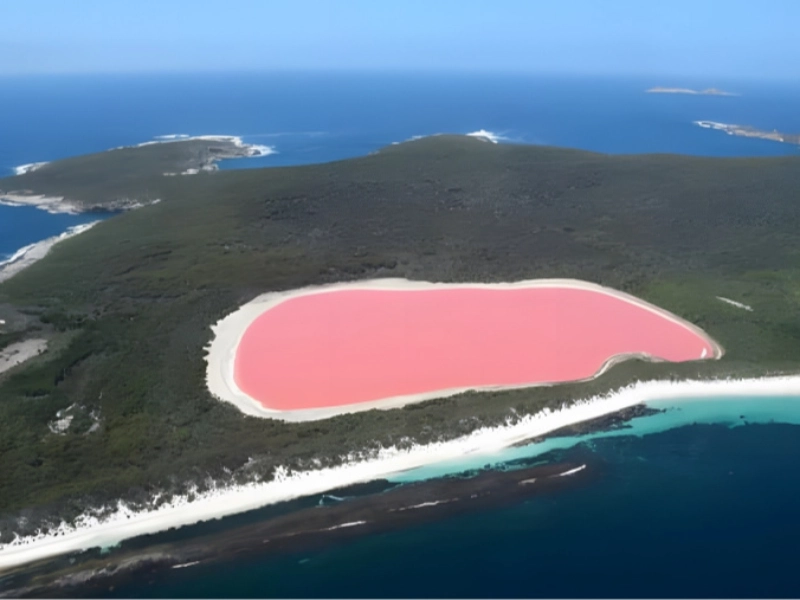
Stunning pink colour of Lake Hillier, a natural occurrence on Middle Island off the coast of Western Australia, captures the imagination. Against the great blue seas of the Southern Ocean, this little, saline lake stands starkly and beautifully encircled by a ring of white salt and a rich woodland of paperbark and eucalyptus trees. Many wonder whether pictures of Lake Hillier had been digitally altered since the lake’s pink hue is so intense and consistent it seems almost bizarre. Still, the lake is among Australia’s most remarkable and strikingly beautiful natural beauties since its unusual hue is totally natural.
For decades both visitors and researchers have been enthralled by the enigma of Lake Hillier’s pink hue. Although the precise explanation is still under investigation and discussion, the general consensus—as indicated—is that red halophilic, (salt-loving) bacteria exist in the salt crusts. These microorganisms—more especially, Dunaliella salina—are supposed to generate carotenoids, a class of pigments ranging in colour from red to pink to orange. Apart from these microorganisms, the lake’s high salinity—ten times that of the ocean—allows few species to flourish. This great salinity, together with other elements including strong light intensity and low nutrition levels, might help these pink-producing microbes proliferate.
Fascinatingly, Lake Hillier’s pink hue remains even after water is taken out and bottled, suggesting that the coloration is inherent in the water itself rather than a result of a trick of light or reflection. This has spurred many theories on the possible presence of other microbes or chemical processes influencing the particular colour of the lake. Some scientists have hypothesised that the interaction between some algae species and the salt-loving bacteria could help to preserve the lake’s constant pink hue independent of temperature fluctuations.
Lake Hillier is “completely safe for swimming,” which is true and lends still another level of mystery to this natural beauty. The lake poses no recognised health hazards to people despite its quite high salt level and unique colour. Actually, the water is surprisingly clean since many dangerous bacteria and pathogens find the hypersaline climate hostile. With the buoyancy given by the high salt concentration comparable to that of the Dead Sea, swimming at Lake Hillier is a singular experience. But Lake Hillier’s distant position and the necessity to preserve its fragile environment mean that access to it is restricted. Most guests observe the lake from the air, on scenic flights over the Recherche Archipelago, which offers a breathtaking perspective of the pink lake against the ocean and surroundings.
The invitation to “enjoy the time of your life” at Lake Hillier addresses the remarkable and unforgettable character of seeing this natural event. For those lucky enough to visit personally, the lake presents more than simply a visual feast. It offers a chance to consider the amazing variety of ecosystems on Earth and the often surprising ways in which life adjusts to challenging surroundings. Lake Hillier reminds us of how much still has to be discovered and understood about our planet and tests our ideas of what is feasible in nature.
Furthermore, Lake Hillier and other pink lakes throughout the world (like Senegal’s Lake Retba or Spain’s Laguna Salada de Torrevieja) have become subjects of growing scientific attention. Studies on the microbes that survive in these hostile conditions could have ramifications for environmental science, biotechnology, and perhaps astrobiology among other disciplines. The study of extremophiles, species living in conditions long deemed too hostile to support life, offers understanding of the possibility for existence in apparently hostile situations, on Earth and maybe on other worlds.
The need of protecting this special habitat increases along with knowledge about Lake Hillier. Although the lake itself is not immediately threatened, growing tourist and researcher interest calls for cautious management to guarantee that human activity does not upset the fragile equilibrium preserving the unique qualities of the lake. With an eye towards not only the source of the lake’s colour but also how this unique environment might be impacted over time by climate change and other environmental issues, efforts are being made to investigate the lake’s ecosystem holistically.
 zw
zw