

7. Beyond Earth: Aurora on Other Planets
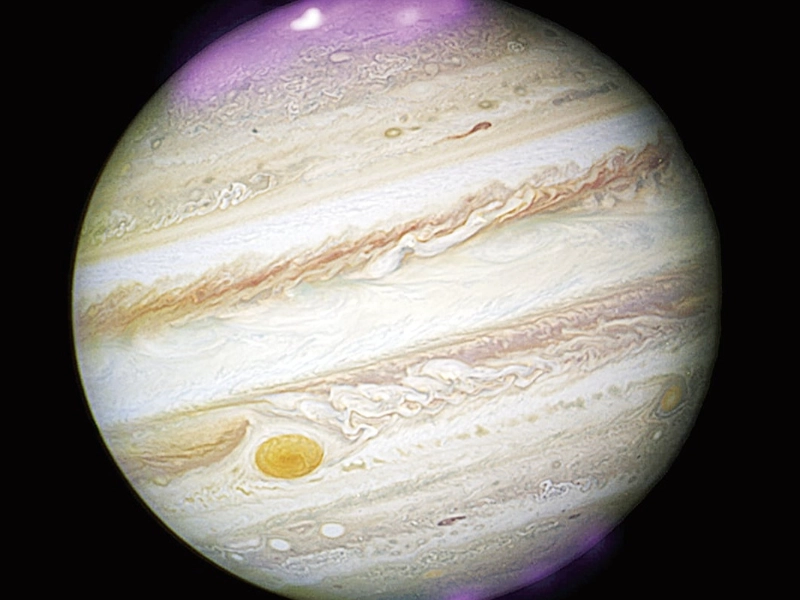
Although the auroras of Earth are surely amazing, our planet is not the only one in the solar system to see these hypnotic light displays. Each of several other planets and even some moons has auroral activity, with individual traits. Investigating these alien auroras not only deepens our knowledge of planetary atmospheres and magnetic fields but also offers insightful analysis of the several ways solar wind interacts with various celestial entities.
The largest planet in our solar system, Jupiter features the most strong auroras seen thus far. Apart from visible light, these Jovian auroras are hundreds of times more energetic than Earth’s and observable at X-ray, UV, and infrared wavelengths. Together with Jupiter’s fast rotation, its powerful magnetic field—roughly 20,000 times greater than Earth’s—forms intricate and dynamic auroral displays. Fascinatingly, Jupiter’s moons—especially Io with their volcanic activity—by injecting material into Jupiter’s magnetosphere help to produce the auroras of the planet. This generates a special interaction between the planet and its satellites that produces auroral characteristics absent on Earth.
Saturn, with its majestic rings, also shows dramatic auroral displays. Mostly seen in the UV range, Saturn’s auroras are somewhat variable. Saturn’s auroras, unlike those of Earth, which are mostly caused by the solar wind, are rather impacted by the planet’s fast rotation and the material expelled from its rings and moons. Saturn’s magnetosphere interacts with its ring system to produce auroral characteristics that pulsate with the planet’s rotation cycle, providing understanding of the intricate electromagnetic environment of this ringed globe.
Mars has a modest magnetic field, yet it experiences a kind of aurora quite different from what Earth experiences. Auroras of the Red Planet are concentrated in areas of crustal magnetism, traces of its former worldwide magnetic field. Thought to be resulting from the interplay between the solar wind and these localised magnetic fields, these “discrete auroras” occur far closer to the surface than Earth’s auroras. Researching Martian auroras clarifies how solar wind interacts with planets having weak or absent global magnetic fields.
Although Venus, the closest planet to Earth, does not have a global magnetic field, it nonetheless undergoes a form of aurora. Direct contact of the solar wind with the ionosphere of the planet generates the Venusian auroras. Instead of the ordered displays observed on Earth, this produces a diffuse glow. The study of Venus’s auroras helps one understand how planets devoid of natural magnetic fields can nonetheless show auroral events.
Auroral activity is exhibited even by some of our solar system’s moons. The biggest moon in the solar system, Jupiter’s moon Ganymede experiences auroras and possesses a magnetic field. Ganymede’s magnetic field and Jupiter’s magnetosphere interact to produce a tiny form of the auroral process observed on Earth.
Though their immense distance from Earth makes their observations difficult, Uranus and Neptune, the icy giants of our solar system, also show auroras. On these planets, the auroras are believed to be caused by a mix of solar wind interaction with the complicated magnetic fields of the planets, which are tilted at extreme angles relative to their rotation axes.
Modern telescopes and space missions have tremendously improved our ability to investigate alien auroras. Unprecedented pictures of the auroras of Jupiter have come from NASA’s Juno spacecraft, therefore exposing fresh information on their genesis and behaviour. From a distance, the Hubble Space Telescope has produced breathtaking pictures of auroras on Saturn and Jupiter that let researchers investigate these events.
By means of comparison of auroras on several planets, one can gain important understanding of the several interactions among magnetic fields, atmospheres, and solar wind. These investigations improve our models of magnetospheric physics and space weather, which have useful relevance for comprehending and forecast of auroral activity on Earth. They also provide a more comprehensive view of the range of electromagnetic events that might transpire in planetary environments.
Furthermore having consequences beyond of our solar system is the discovery and study of extraterrestrial auroras Knowing how various kinds of planets interact with the stellar winds of their parent stars becomes essential as we hunt possibly habitable exoplanets. Auroras on exoplanets could offer important insights on their magnetic fields and atmospheres, important determinants of their possible habitability.
Furthermore, the study of auroras on other planets questions our knowledge of what really qualifies as a “aurora.” The several forms these events take across our solar system broaden our definition and provide fresh directions for study. For example, the finding of UV auroras on comets has caused us to rethink our definition of these light displays and the requirements for their generation.
We should find even more information about auroras around the solar system as our technologies develop. Future missions including those intended to investigate the moons of Jupiter and Saturn could expose fresh forms of auroral activity or offer more detailed information on well-known events. Set to launch not too far off, the JUICE (JUpiter ICy moons Explorer) mission of the European Space Agency seeks to investigate Jupiter and its largest moons, therefore providing fresh understanding of the intricate auroral processes in the Jovian system.
Investigating auroras outside Earth reminds us of the interdependence of our solar system and the universal laws controlling celestial bodies. From the iconic curtains of light in our night sky to the X-ray emissions of Jupiter’s poles, auroras are exquisite, dynamic reminders of the invisible forces sculpting our cosmic neighbourhood. < We not only increase our scientific knowledge but also develop a greater respect of the beauties of our planet as we keep solving the riddles of these otherworldly light displays.
Ultimately, research of auroras around the solar system connects several scientific fields, including planetary science and plasma physics. It emphasises the commonalities among planetary habitats even as it shows their variation. The auroras are a lighthouse of discovery, beckoning us to untangle the secrets of the universe and our role within it as we gaze to the stars and dream of visiting other worlds.
 zi ang