
8. Jerboa
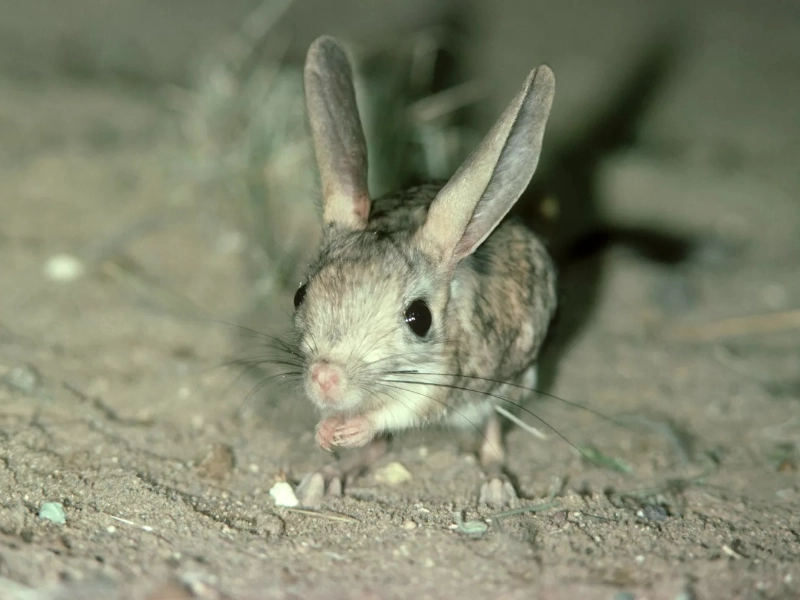
Fascinating member of the Dipodidae family, the jerboa is a great illustration of adaption to desert conditions. Found in North Africa, China, and Mongolia, these small, kangaroo-like animals have developed to survive in some of the toughest conditions on Earth, including the sweltering Sahara and the freezing Gobi Desert. Jerboas’ long hind legs, short forearms, and big eyes help them to negotiate the difficulties presented by their dry surroundings.
The odd shape of the jerboa is among its most arresting characteristics. Long hind legs of the jerboa enable it to travel large distances rapidly and reduce energy consumption by permitting strong leaps. In desert settings, where food and water might be limited and mobility is very vital for both foraging and predator escape, this adaptation is especially helpful. Jerboas are also suited for digging with their short forearms, which helps them to build large tunnelling systems offering escape from the high temperatures of their habitat.
The jerboa depends on these burrows since they fulfil several functions. Jerboas hide underground to escape the intense heat during the warmest portions of the day, where temperatures stay much lower than on the surface. Since the colder surroundings lessens their need for water, this behavioural modification helps them preserve energy and keep hydration. The burrows also offer defence from predators, which lets jerboas relax until the conditions are better for feeding.
Diet-wise, jerboas are essentially herbivorous, consuming seeds, roots, and other plants present in their arid environments. Their specialised digestive systems help them to collect moisture from the food they eat, therefore permitting their survival for long stretches without direct access to water. Showcasing their amazing resilience to arid environments, jerboas have shown in laboratory trials the astounding capacity to survive off of dry seeds for up to three years. This capacity to flourish on few resources is evidence of the jerboa’s tenacity in its demanding surroundings.
Jerboas also have special adaptations to enable them negotiate their sandy environments. Their skin folds allow them to seal their nostrils, therefore stopping sand from getting in under windy conditions. Their great night vision from their big eyes also lets them be mostly nocturnal foragers. By evening activities let them avoid the intense heat of the day and lessens conflict with other desert-dwelling species.
All things considered, the jerboa is an amazing model of adaption to desert existence. Its morphological traits, burrowing behaviour, and dietary adaptability draw attention to the species’s fortitude in some of the most demanding habitats on Earth. Understanding the special adaptations of the jerboa will be essential for its preservation and the protection of the delicate equilibrium in these arid environments as climate change and habitat loss still endanger desert ecosystems.
 zi ang