
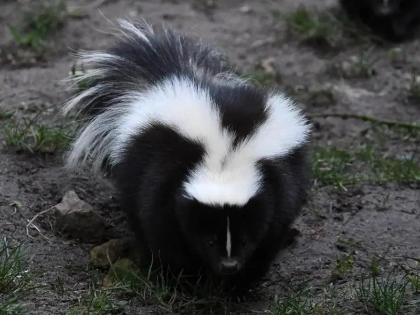
7. Skunks as Bee Predators: An Ecological Balancing Act
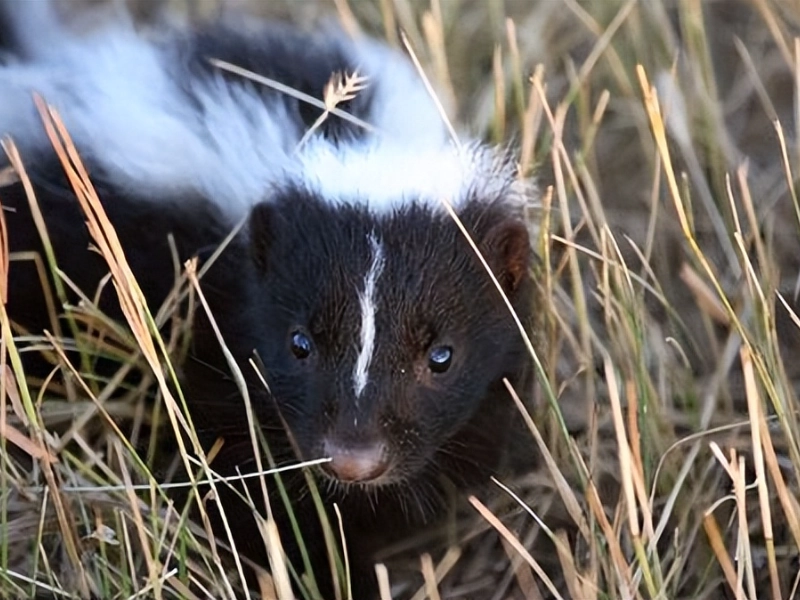
With their omnivorous diet and flexible feeding behaviour, skunks have a complicated role in many ecosystems. Although their eating of small mammals, insects, and plant matter is well known, their interaction with bees is especially important and occasionally controversial. Skunks have become rather important bee predators in many areas, a behaviour with ecological, financial, and conservation consequences.
Skunks’ eating patterns are essentially opportunistic and change based on their location and the availability of food supplies. In settings where beehives—wild or under control by beekeepers—exist, skunks have shown an amazing capacity to maximise this abundant supply. Not confined to adult insects, skunks also eat bee larvae, which are high in protein and readily digested.
Especially the striped skunk (Mephitis mephitis), has been noted to be a skilled bee hunter. These skunks use several methods to get at beehives. They might scrape at the hive’s entrance to set off the bees’ emergence, then eat the enraged insects as they fly out to guard their colony. To reach the honeycomb inside, where they can feast on both adult bees and their young, skunks have also been known to topple over hives or breach the outer construction.
This predatory behaviour reveals the skunk’s intelligence and capacity for addressing problems. Skunks’ thick fur helps them to resist the defence measures of bees by somewhat shielding them from bee stings. Skunks also frequently assault hives at night when bees are less active and less suited for a defence.
Ecologically speaking, the interaction between skunks and bees is a part of the natural predator-prey dynamics preserving equilibrium in ecosystems. Natural environments may allow this predation to help control wild bee numbers and affect bee colony dispersal and behaviour. But in the context of regulated beehives and agricultural environments, the effects of skunk predation on bees get more complicated and maybe dangerous.
Skunk predation can be quite dangerous for beekeepers’ colonies. Skunks’ repeated attacks on beehives can weaken or destroy them, therefore causing financial losses and difficulties for crop pollination services. Skunk assaults can also generate stress that increases the vulnerability of bee colonies to illnesses and other threats, therefore aggravating the difficulties experienced by beekeepers.
The problem of skunk predation on bees crosses with more general worries about pollinator welfare and preservation. Both wild and controlled, bees are absolutely vital for pollinating a great range of plants, including many major crops. Disease, chemical exposure, and habitat loss are just a few of the several hazards bee populations have encountered recently. In this regard, skunk predation imposes still another level of strain on already fragile bee numbers.
Still, one should approach this problem from a reasonable distance. Like other animals, skunks have an inherent right to live and are vital members of their ecosystems outside their interactions with bees. By eating insects and small rodents, they help manage pests; they also provide food for bigger predators, therefore augmenting the food web.
Many times, attempts to limit skunk predation on controlled beehives centre on non-lethal deterrent strategies. Among these are:
One could say that raising beehives to make them less skunk accessable
Two. Around apiaries, erect physical barriers like fencing.
Three. Using motion-activated sprinklers or lights to discourage late night guests
Four. Making use of specifically made hive gates that let bees pass but forbid bigger animals
These strategies seek to safeguard bee colonies while honouring the ecological function of skunks and so preventing needless conflict between human activities and wildlife.
Furthermore providing chances for scientific study is the interaction between skunks and bees. Understanding this predator-prey dynamic helps one to grasp animal behaviour, ecological adaptations, and the intricate interactions inside ecosystems. It might also help us to better grasp the responses of many animals to altered surroundings and human-made landscapes.
Finally, the interesting feature of natural history that interacts with human agricultural activities and conservation initiatives is the predation of bees by skunks. It emphasises the difficulty of ecological interconnections and the difficulties in juggling human economic goals with wildlife protection. Understanding and controlling these complex interactions becomes ever more crucial for healthy cohabitation between humans and wildlife as we still struggle with problems of biodiversity loss and ecological change.
8. Skunks in Urban Environments: Adapting to Human Habitats
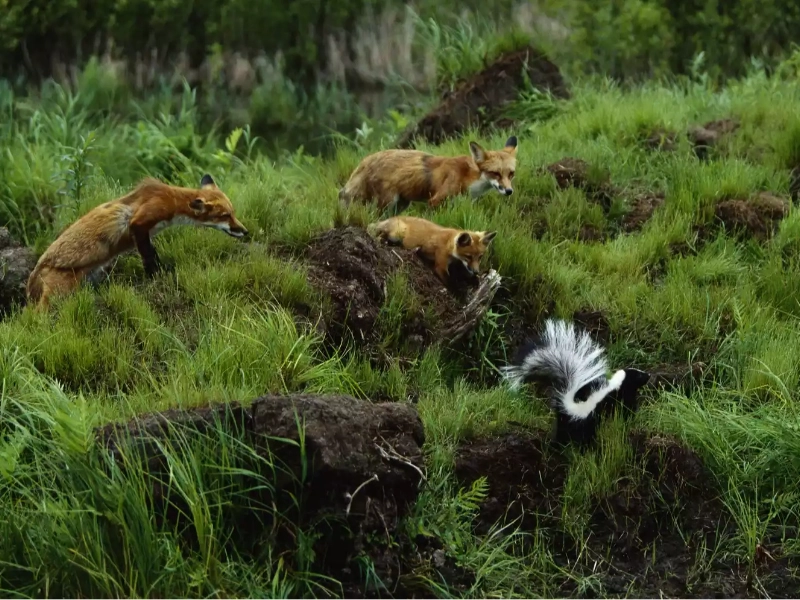
Many wildlife species find themselves negotiating an increasingly human-dominated environment as human populations keep rising and metropolitan areas develop. Given their flexible nature and omnivorous diet, skunks have shown very effective adaptation for urban and suburban settings. Skunks are a fascinating case study in urban ecology and human-wildlife interactions since this capacity to coexist with humans presents both possibilities and problems.
Urban skunks’ success can be ascribed to various elements. First of all, their omnivorous diet lets them profit from a variety of food sources usually present in human communities. From falling fruit and human food waste to insects and tiny rodents, metropolitan surroundings provide a real feast for these opportunistic eaters. In urban environments, the quantity of freely available food sometimes results in greater skunk numbers than in their natural surroundings.
Second, metropolitan environments offer skunks several appropriate denning sites. They might settle under abandoned buildings, in crawl spaces, or on porches. Attractive choices for skunks, these manmade buildings usually provide better defence from the elements and predators than natural dens. Moreover, especially in colder areas, the warmth produced by buildings and the urban heat island effect might make the atmosphere more friendly for skunks.
Skunk presence in cities provides advantages as well as drawbacks. Positively, skunks can be naturally occurring pest management agents, helping to control populations of insects, rats, and other small animals that might otherwise cause problems in metropolitan environments. In metropolitan green areas, their foraging activities can also help to distribute seeds and aerate soil.
Still, close closeness of skunks to human civilisation causes several problems. Transmission of rabies raises one of the main worries. Although skunks are not naturally more likely than other wild animals to have rabies, their inclination to live close to people raises the likelihood of interactions. In many metropolitan areas, this has resulted in more focus on public education on wildlife interaction and rabies vaccination programs.
Property damage is another often occurring problem. Skunks may dig up lawns in pursuit of grubs or other insects, destroy gardens while foraging for fruits and vegetables, or build ugly and maybe dangerous burrows. Additionally causing harm and requiring expensive repairs is their inclination to den under human constructions.
Though mostly a defensive tactic, the notorious skunk spray becomes a more regular issue in urban environments where interactions between skunks and people or dogs are more likely. In severe circumstances, the constant and bad smell can be a major annoyance that influences quality of life and maybe property values.
Many cities and municipalities have created wildlife management plans especially aiming at urban skunks in order to handle these problems. Usually rather than eradication or elimination, these centre on education and prevention. Typical advice consists of:
One .could say Getting garbage cans and compost bins will help to limit simple food accessibility.
Two. Eliminating possible den sites by closing access to crawl spaces and areas beneath porches
The third is Motion-activated lights or sprinklers help discourage skunks from yards.
Four.Correctly storing pet food and avoiding outside feeding of animals
The five are keeping gardens and grass to lower the numbers of insects drawing skunks
Many places today stress humane wildlife control techniques when problems do develop. These could be the use of repellents to deter skunks from visiting particular places or one-way exclusion doors allowing skunks to depart den sites but not return.
Skunks present special chances for study and education in metropolitan settings as well. Urban ecologists investigate how these species negotiate city life, therefore illuminating evolutionary processes and the effects of urbanisation on species. These research can guide improved methods of urban development and animal management.
Moreover, the presence of skunks in cities presents opportunity for public interaction with animals. Programs for education can encourage coexistence between people and animals and respect of urban biodiversity. These days, many localities have wildlife hotlines or programs to assist their citizens in humanely and successfully handling skunk-related problems.
The ability of species like skunks to fit human-dominated environments becomes more crucial as metropolitan areas keep growing internationally. Their success story in metropolitan settings pushes us to design more inclusive urban ecosystems that can support both human needs and biodiversity as well as provide insightful insights on wildlife adaptability.
Finally, the occurrence of skunks in metropolitan settings reflects a complicated interaction among ecological adaptability, human-wildlife conflict, and conservation possibilities. Understanding and controlling human interaction with urban wildlife like skunks will be essential in building sustainable, biodiverse cities of the future as we continue to modify our metropolitan settings.
 zi ang