
6. Soaring to New Heights: Avian Formation Flight Inspires Fuel-Efficient Air Travel
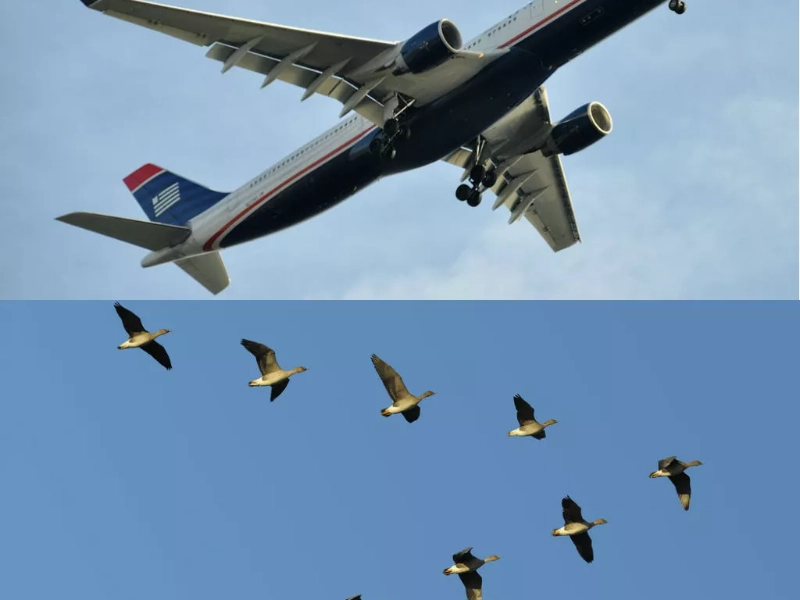
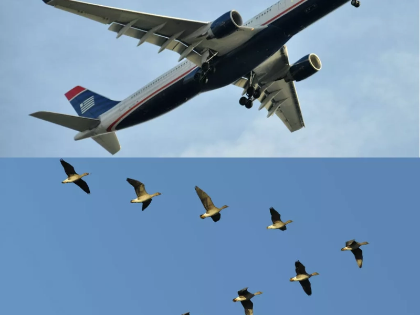
Human viewers have long been enthralled with the amazing sight of birds flying in V-formation, but it is only lately that researchers have really come to value the aerodynamic brilliance underlying this natural occurrence. Through millions of years of evolution, birds have evolved a clever way to save energy on long-distance flights—a tactic that has lately attracted the interest of aerospace engineers and airline business analysts. Studies have revealed that flocks of birds can significantly improve their flight efficiency by using the known V-shape configuration, therefore increasing their travel distance by an amazing 70% or more. By means of a complex interaction between timing and placement, this amazing feat of natural engineering is accomplished whereby every bird in the formation helps and gains from the group efforts. Every bird flaps its wings to produce a little updraft that lifts the bird just behind it. With each bird contributing its energy to the system, this effect runs through the whole formation and helps the whole flock to keep flight with far less personal effort.
This avian energy-saving method has elegant yet sophisticated mechanics. Those behind the lead bird can ride this wave of air, therefore lowering their own energy consumption as the lead bird expends it producing the first updraft. The arrangement is not fixed, though; birds change their positions along the trip, alternately in the more difficult front posture. This rotation guarantees even distribution of the effort among the flock, therefore enabling continuous effective flying over great distances. Birds keep ideal posture and timing to maximise the advantages of the updrafts, thereby requiring an amazing degree of accuracy for this manoeuvre. This natural system has evolved to such a degree of efficiency that it renders many of our human-engineered solutions obsolete and motivates researchers to investigate how we may adapt these ideas to our own long-distance travel.
Inspired by this avian wonder, a group of creative Stanford University researchers under Professor Ilan Kroo has started an ambitious endeavour to bring the ideas of bird formation flight to commercial aircraft. Their ambition is nothing less than revolutionary: a situation whereby passenger planes from West Coast airports meet mid-air and fly in formation to their East Coast targets. The team speculates that by using a V-shaped arrangement like that employed by migrating birds, with aircraft taking turns in the lead position, planes might save fuel of up to 15% compared to flying solo. When one considers the worldwide aviation fuel usage and related environmental impact, this possibility for higher efficiency is astounding.
Successful application of such a system has far-reaching consequences. In a time when the aviation sector is under more and more pressure to lower its carbon impact, any notable fuel usage cut would be revolutionary. Long-haul flights’ 15% fuel consumption cut might result in billions of annual savings for airlines, thereby influencing consumer ticket prices. More crucially, it would show a significant decrease in aviation sector greenhouse gas emissions, therefore supporting worldwide initiatives to slow down global warming. Beyond only lower carbon emissions, less fuel use implies fewer resources harvested and refined, therefore further reducing the whole ecological effect of air travel.
Translation of this idea from avian biology to commercial aviation, however, offers many difficulties. Unlike birds, which have developed over millions of years to execute these motions automatically, aircraft would need complex systems to keep safe distances and ideal orientation inside the formation. Systems of air traffic control would require major overhauls to coordinate the mid-air rendezvous of several aircraft and regulate these formations over large distances. Pilots would also need specific instruction to run in such close proximity to other aircraft for prolonged lengths of time. Furthermore to be addressed are legal obstacles since present aviation regulations are not intended with formation flying in mind.
Notwithstanding these difficulties, the possible advantages make this field of study desirable. Technical constraints to using bird-inspired formation flight may progressively be removed as processing capability rises and autonomous flight systems get more sophisticated. The Stanford University research marks only the start of what might be a paradigm change in our attitude to long-distance aviation. It reflects the creative ideas needed to solve the difficult problems confronting the aviation sector in the twenty-first century.
Furthermore, this study emphasises the more general possibilities of biomimicry in addressing problems of human engineering. Seeing and copying nature’s time-tested answers can help us create technologies that are not only more harmonic with the environment but also more efficient. One instance of how knowledge from the natural world can inspire ideas across several disciplines, from energy generation to materials research, is the study of bird formation flight for aviation uses.
The wisdom contained in natural designs provides a great resource as we keep stretching the boundaries of technology and looking for answers to world problems. The narrative of birds motivating more effective air travel reminds us strongly that some of the most significant discoveries could result from just observing the surroundings. It forces us to approach problem-solving with humility and openness, realising that nature, via the unrelenting process of evolution, has often already evolved exquisite answers to difficult issues. The heavens above and the species living in them may hold the key to unlocking a more sustainable future for air travel and beyond as we confront the urgent demand for more efficient and environmentally friendly technologies.
 zi ang