
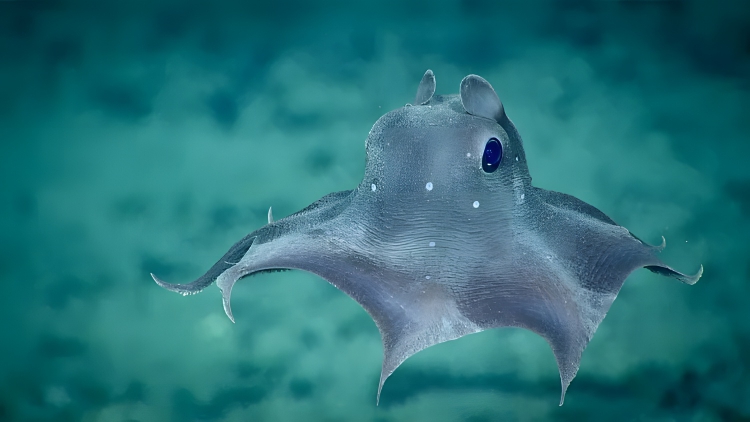
The dark, cold, high-pressure environment of the deep ocean has created a diversity of marine life with little resemblance to the shallower animals we are much more familiar with. While deep-sea creatures have adapted many different ways to live in the deep ocean—such as light organs, missing eyes, and wild horns—these 10 deep-sea animals all have one thing in common: They are absolutely bizarre.
Giant Isopod
:max_bytes(150000):strip_icc():format(webp)/giant-sea-isopod-1126954345-2a125db9334c43599bc3bd2105c26aa4.jpg)
Deep-sea pressure has churned out this massive “giant isopod”—perhaps somewhat literally. The isopod’s disturbing size is just one example of what scientists call “deep-sea gigantism”, when animals found deep in the ocean are many times the size of their shallow-water relatives. In the deep ocean, the weight of the thousands of feet of water overhead makes for a high-pressure abyssal environment. Scientists suspect this deep-sea pressure, the scarcity of food in the deep ocean, or the cold temperatures gives larger creatures like the giant isopod an advantage on the ocean floor.
Dumbo Octopus
:max_bytes(150000):strip_icc():format(webp)/19156780454_a086a7bd94_o-25e12bb64a194db1ad9a22730a777f15.jpg)
The odd, adorable, deep-sea “dumbo” octopus is not the name of a single species, but instead refers to an entire genus of umbrella octopuses. As a group, dumbo octopuses are known to live over 22,000 feet deep, living deeper than any other octopuses. The animal uses its characteristic ear-like flaps to help it swim.
Faceless Cusk
Before resurfacing during a scientific expedition in 2017, this “faceless fish” had not been documented since the 19th century when it was pulled up by the HMS Challenger. The fish only recently gained its creepy name from its lack of distinguishable eyes, eye-like nostrils, and underslung mouth which together mask any appearance of a normal fish face. Although the faceless cusk’s snake-like shape resembles that of an eel, the strange, deep-sea animal is a true fish. The animal is closely related to the similarly serpentine pearlfish.
Pacific Blackdragon
:max_bytes(150000):strip_icc():format(webp)/illustrated-side-view-of-black-dragonfish--idiacanthus-antrostomus---a-deep-water-marine-fish-with-a-snake-like-body--large-teeth-and-a-barbel-protruding-from-the-lower-jaw--72196709-0db9374284b74cea86ead9ccf005fcff.jpg)
The female pacific blackdragons’ sleek black body allows the fish to hide in the darkness of the deep sea and makes the animal well-suited for its characteristic ambush-style of attack. Using a light organ that dangles from its chin, the eel-like fish lures in prey before mounting an attack. Male pacific blackdragons are not equipped with these special features, are much smaller than females, and even lack the ability to feed themselves. Instead, the males live just long enough to reproduce.
Ram’s Horn Squid
:max_bytes(150000):strip_icc():format(webp)/ram-s-horn-shells-in-a-circle-175233843-e6f4dfc86ad24152abcc2d77e2844a5f.jpg)
The ram’s horn squid is aptly named for the delicate spiral horn-like shells the squid creates. The rarely-seen squid was first captured on camera in its natural habitat in 2020. However, the recent footage surprised scientists, who expected the squid’s buoyant horn-like shells to be oriented towards the ocean’s surface. Instead, the video shows the squid operating in the opposite direction, buoyant horns down.
Japanese Spider Crab
:max_bytes(150000):strip_icc():format(webp)/15340536895_d31b17dd90_k-3d8ea4646978421fb0a2b1bb09cba036.jpg)
The Japanese spider crab boasts the largest leg span of all arthropods, spanning up to 12.5 feet from claw to claw. The long-legged crab lives up to 1,500 feet deep, but uses shallow waters for spawning. The deep-sea animal thrives in the cold temperatures found at the ocean’s depths.
Armored Sea Robin
:max_bytes(150000):strip_icc():format(webp)/27906974956_724a2eff1c_k-9883b1f2c6dd47769666b6498f49d9d2.jpg)
The armored sea Robin, or armored gurnards, are the deep-sea version of a fish common in shallower water. Both the deep-sea and shallow types of sea robins use their pectoral fins to crawl along the seafloor, but this action is decidedly creepier in the bonier deep-sea armored sea robin. The deep-sea version of the fish is also flatter than other sea robins giving the fish an unusual, alien-like appearance.
Goblin Shark
:max_bytes(150000):strip_icc():format(webp)/goblin-shark-1213433646-7ce0a742793942e79f27ee8c1824b71c.jpg)
This rare deep-sea shark is so strange, it hardly even looks like a shark. The goblin shark has a long snout that is used to sense electric fields in the darkness of the deep ocean. When prey is near, the goblin shark can extend its jaws past the length of its snout for an ambush-style attack.
Sea Pig
:max_bytes(150000):strip_icc():format(webp)/Scotoplanes_globosa_and_crab1-d1673aa5d2b34b2681af68179f43e503.jpeg)
Not a pig, but rather a sea cucumber of sorts, these blobby creatures (Scotoplanes globosa) have numerous tube-like legs—some protruding from their heads—and crawl along the sea floor in groups of sometimes hundreds. They are found only in very deep waters. Their pinkish skin is translucent, their bodies measure up to six inches in length, and they’re described by one source as looking like a “bloated, water-filled sausage.”
Blob Sculpin
:max_bytes(150000):strip_icc():format(webp)/Psychrolutes_phrictus1-cb6da7c669e14001a5105197f18f5a57.jpeg)
Like a creature from a horror film, the blob sculpin is usually found as deep as 9,200 feet (2,800 meters) off North America’s Pacific coast, from the Bering Sea to southern California. It can grow up to 2 feet in length and eats small invertebrates.
Proboscis worm
:max_bytes(150000):strip_icc():format(webp)/Nemertea_Reunion1-70332e23bc1f4baf961a0ffa465275bd.jpeg)
These worms, also known as ribbon worms, grow up to 6.5 feet (2 meters) in length and scavenge along the ocean floor, where they have few predators. They eat pretty much anything they come across. They are named for their proboscis, a unique muscular structure in their body that gets pushed out to attack prey. Many of these worms can regenerate when a predator takes a bite.
Stonefish
:max_bytes(150000):strip_icc():format(webp)/Synanceia_verrucosa_Reunion1-a6163a7139f44d4081bfecb14f131ffe.jpeg)
This ugly critter takes the prize as the world’s most venomous fish. It is camouflaged to look just like a rock on a coral reef, but it has 13 venom-releasing spines on its back that are enough to kill a human within hours. Found in Australia, they measure between 12 and 16 inches. Despite being slow swimmers, they can attack and swallow prey in as little as 0.05 seconds.