
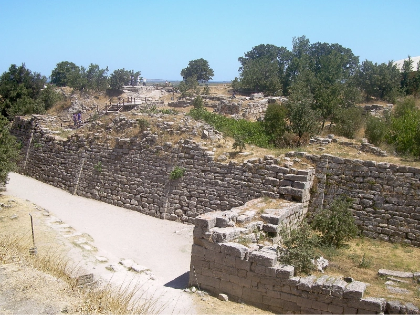
2. Archaeological Discoveries: Unearthing the Layers of Troy
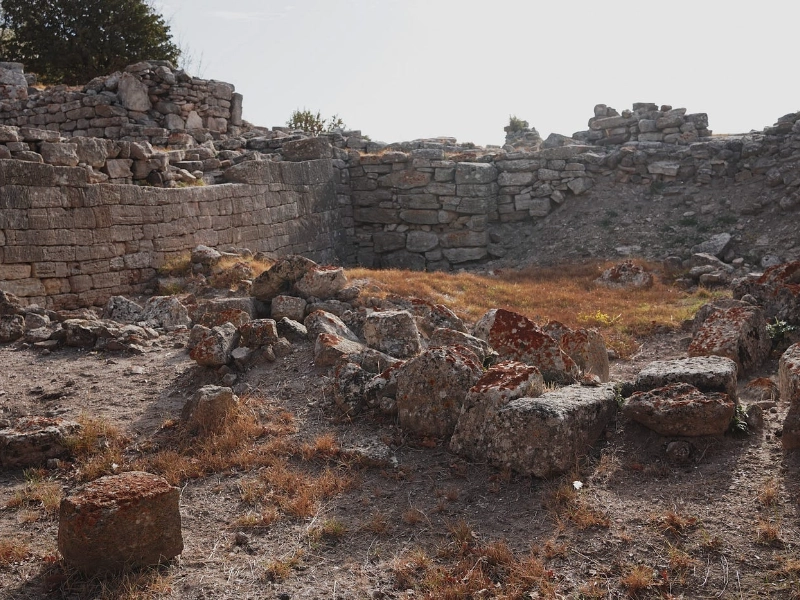
Beginning with the pioneering efforts of Heinrich Schliemann, the search to find Troy’s physical remains took front stage in the 19th century. This German merchant turned archaeologist was persuaded that Homer’s Troy was a genuine location just waiting to be unearthed rather than as a tale. Beginning excavations at the site of Hisarlik in north-west Turkey in 1870, Schliemann thought he was at the site of ancient Troy.
Though their techniques by today’s standards debatable, Schliemann’s excavations exposed a sequence of towns stacked one atop another across thousands of years. At first, he recognised what he assumed to be “Priam’s Treasure,” a collection of gold and silver relics he thought belonged to the Trojan king mentioned in Homer’s Iliad: Later study, however, revealed that these artefacts were several millennia ahead of the expected Trojan War era.
Early 20th-century excavations by Wilhelm Dörpfeld and Carl Blegen helped us to better grasp Troy’s past. With multiple sub-phases inside each of the at least nine main periods of settlement found at the site, they labelled Troy I through Troy IX. Troy VIIa, from roughly 1180 BCE, is the layer most usually connected with Homer’s Troy; it exhibits signs of conflict and destruction by fire.
Contemporary archaeological methods have been producing fresh understanding of the site. Advanced imaging technologies, radiocarbon dating, and geophysical surveys have let scientists more precisely date the several eras of the ancient metropolis and map it more generally. These techniques have exposed a sophisticated urban centre with remarkable defences, big public structures, and traces of strong commerce networks.
Among the most important recent findings at Troy was the discovery of a sizable lower city outside the citadel gates. This space, which might have housed thousands of people, points to Troy’s being a far bigger and more significant metropolis than hitherto believed. This lower city’s excavations have revealed homes, businesses, and traces of industrial activity as well as workshops, therefore depicting a vibrant Bronze Age city.
The continuous archaeological effort at Troy keeps testing and improving our knowledge of the past of the site. Although the excavations have unearthed a rich and complicated history spanning more than 3,000 years, they have not offered clear evidence of the Trojan War as Homer describes. The site’s strategic location, remarkable architecture, and traces of dramatic destruction at several stages in its history all support Troy’s major contribution to the geopolitics of the ancient Mediterranean world
 zi ang