
9. Blood Falls: Antarctica’s Crimson Mystery
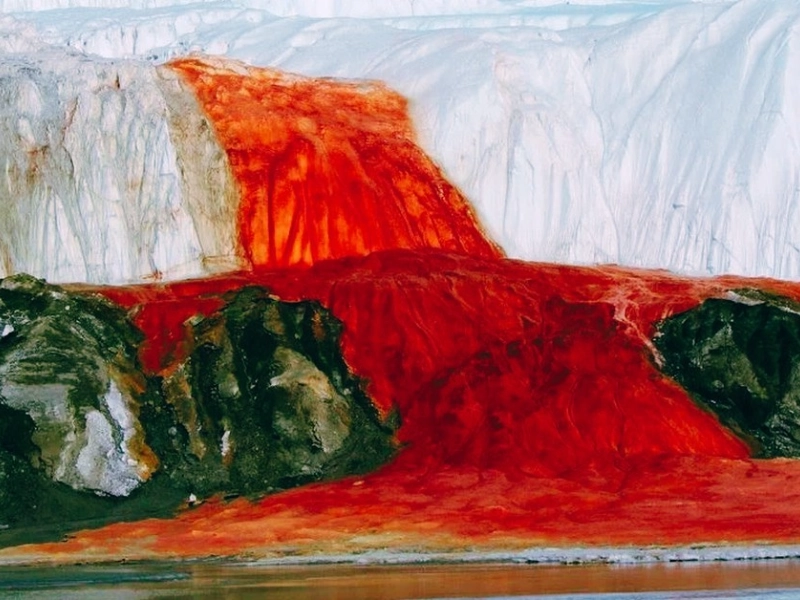
Against the immaculate white ice and desolate rock of the isolated and inhospitable McMurdo Dry Valleys in Antarctica, a spectacular geological event known as Blood Falls stands out. At the terminus of Taylor Glacier, this distinctive characteristic shows itself as a vivid red stain falling down the glacier’s face, producing an almost unnatural contrast in intensity. Since its discovery in 1911 by geologist Griffith Taylor, for whom the glacier is named, the sight of what looks to be blood flowing from the ice has captivated both scientists and tourists alike.
For decades, the source of Blood Falls remained a mystery; early researchers and scientists put out several ideas to explain its peculiar hue. Some first thought the unique colour came from crimson algae. But this explanation seemed improbable given the area’s severe conditions—subzero temperatures and little sunlight for much of the year. Modern scientific methods only let researchers uncover the actual nature of this Antarctic mystery in recent years.
Blood Falls starts not with the obvious outflow but rather deep beneath the surface of Taylor Glacier in a subglacial lake isolated from the outer world for an estimated 1.5 to 2 million years. Understanding the special qualities of the falls depends on this ancient store of water caught behind 400 metres (1,300 feet) of ice. Rich in iron, the lake’s water is hypersaline with a salt concentration around three times that of saltwater. Even at temperatures much below 0 degrees Celsius, this high salt concentration keeps the water from freezing.
Blood Falls’ creation depends critically on the iron concentration of the subglacial lake. For the first time in millions of years, the iron-rich lake water contacts oxygen as it flows through fissures in the glacier. This contact sets off a chemical reaction whereby the iron oxidises, or rusts, giving the output its characteristic blood-red hue. Though in this case it occurs on a much larger and more spectacular scale, the process is comparable to what happens when iron left in the air develops a reddish-brown covering of rust.
Blood Falls’s remarkable look is only one reason why scientists find it very intriguing; another is what it tells about the possibility for life in hostile conditions. Unique microorganisms in the subglacial lake feeding Blood Falls have evolved to thrive in conditions of total darkness, extreme cold, and high salt. The chemical reactions that provide Blood Falls its colour depend critically on these microorganisms. Metabolising the few amounts of organic debris caught with them in the subglacial lake, they “breathe” using ferric iron using sulphate as a catalyst. This technique preserves the iron in a reduced, soluble form therefore enabling its flow out with the brine and oxidation upon air exposure.
The study of life in the cosmos, or astrobiology, depends much on the discovery of this vibrant microbial population in such a hostile environment. It implies that life could exist in similarly hostile circumstances on other planets or moons, including under the ice-covered surface of Jupiter’s moon Europa or in the underground waters of Saturn’s moon Enceladus. Blood Falls’ microorganisms show the amazing adaptability of life and help us to better grasp the circumstances under which species might live and even flourish.
 zi ang